

Gen X Was Built for Trauma-Informed Leadership — But Not If They're Running on Empty
Gen X is the most naturally prepared generation to lead the modern workplace. They are also the most likely to burn out doing it.
That is not a contradiction. It is the central paradox of Gen X leadership — and understanding it is the difference between organizations that stabilize in this moment and ones that quietly fracture under leaders who had all the right instincts and not quite enough capacity to sustain them.
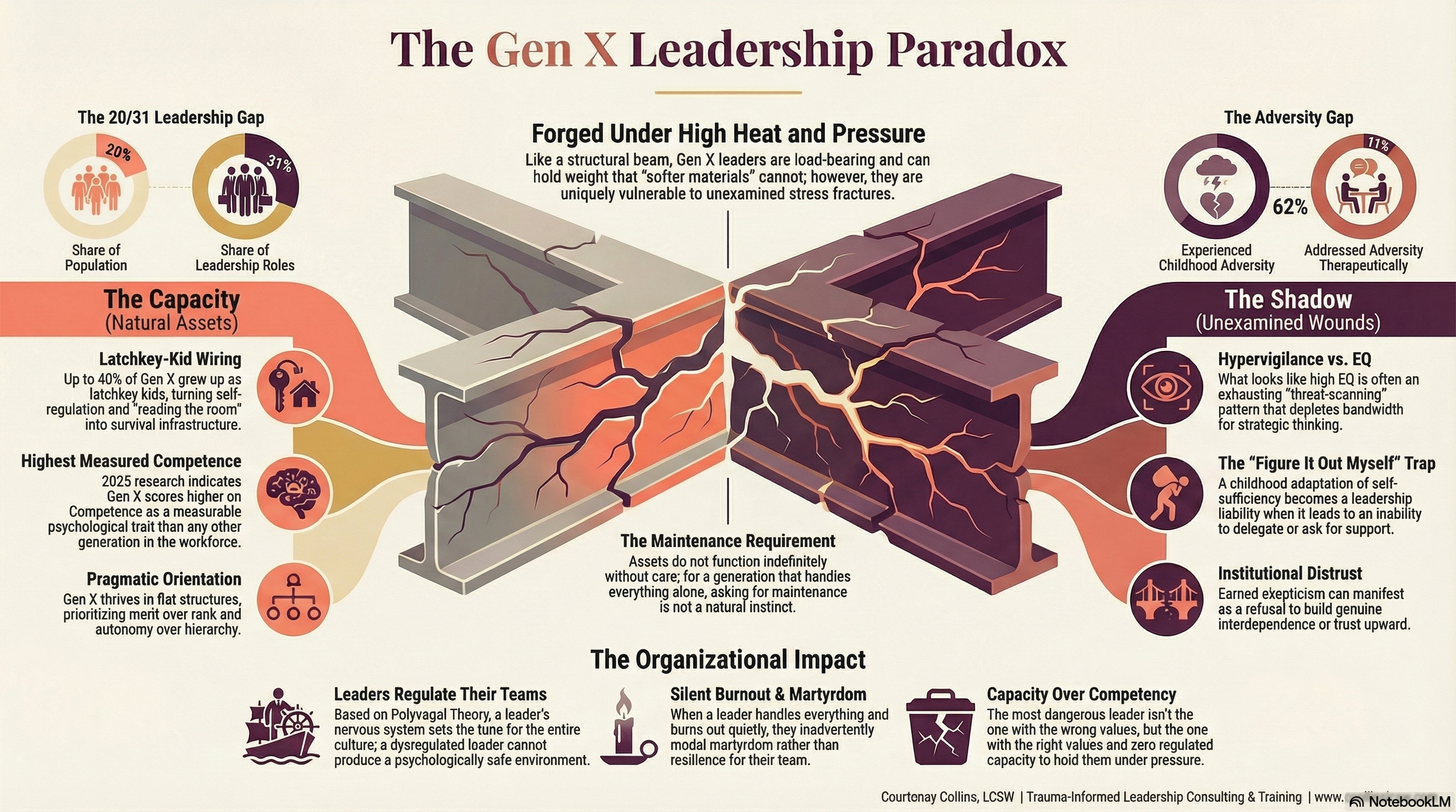
Picture a structural beam that was forged under high heat and pressure. The forging process is exactly what makes it load-bearing. It can hold what softer materials cannot. But if you add weight without ever inspecting for stress fractures — if you keep loading the beam because it keeps holding — eventually, what made it strong becomes the mechanism of its failure.
Gen X leaders are that beam. The adversity, self-reliance, and earned skepticism of institutions that shaped them in childhood are genuine organizational assets. But assets do not function indefinitely without maintenance. And for a generation that learned early to handle everything alone, asking for that maintenance often does not come naturally.
This post is for organizations that want to understand what Gen X leaders carry into this moment — the strengths, the weight, and the specific vulnerabilities — and what it actually takes to support them well enough to lead well.
Why Latchkey-Kid Wiring Is a Nervous-System Asset in Modern Leadership
Before we get to the risks, the strengths deserve to be named clearly — because they are real, and they are significant.
As many as 40% of Gen Xers grew up as latchkey kids: children who came home to empty houses, figured out dinner, managed their own time, and navigated their afternoons without adult supervision. Self-regulation was not a skill course they took. It was survival infrastructure. You learned to read the room — the tone of the house, the mood of a parent arriving home — because your wellbeing depended on it.
That early training produced something valuable: a generation with high tolerance for ambiguity, low attachment to status for its own sake, and a fundamentally pragmatic orientation toward authority. Psychological data from Solsten's 2025 generational research shows that Gen X scores higher on Competence than any other generation currently in the workforce. Not just competence as self-perception — competence as a measurable psychological trait that shapes how they approach problems, relationships, and pressure.
For organizations trying to move away from the compliance-based, hierarchy-first culture that Boomer leadership often installed, those traits are not incidental. They are exactly what the shift requires. Flat structures, merit over rank, autonomy and accountability held together — these are the conditions in which Gen X leaders tend to thrive and lead well. They are also, not coincidentally, the conditions most strongly associated with psychological safety and high performance.
Practical takeaway: When developing or promoting Gen X leaders, invest in structures that match their operating style — autonomy with accountability, transparency over hierarchy, outcomes over optics. Fighting their wiring is a waste of everyone's resources.
The Weight They Were Already Carrying Before They Got the Title
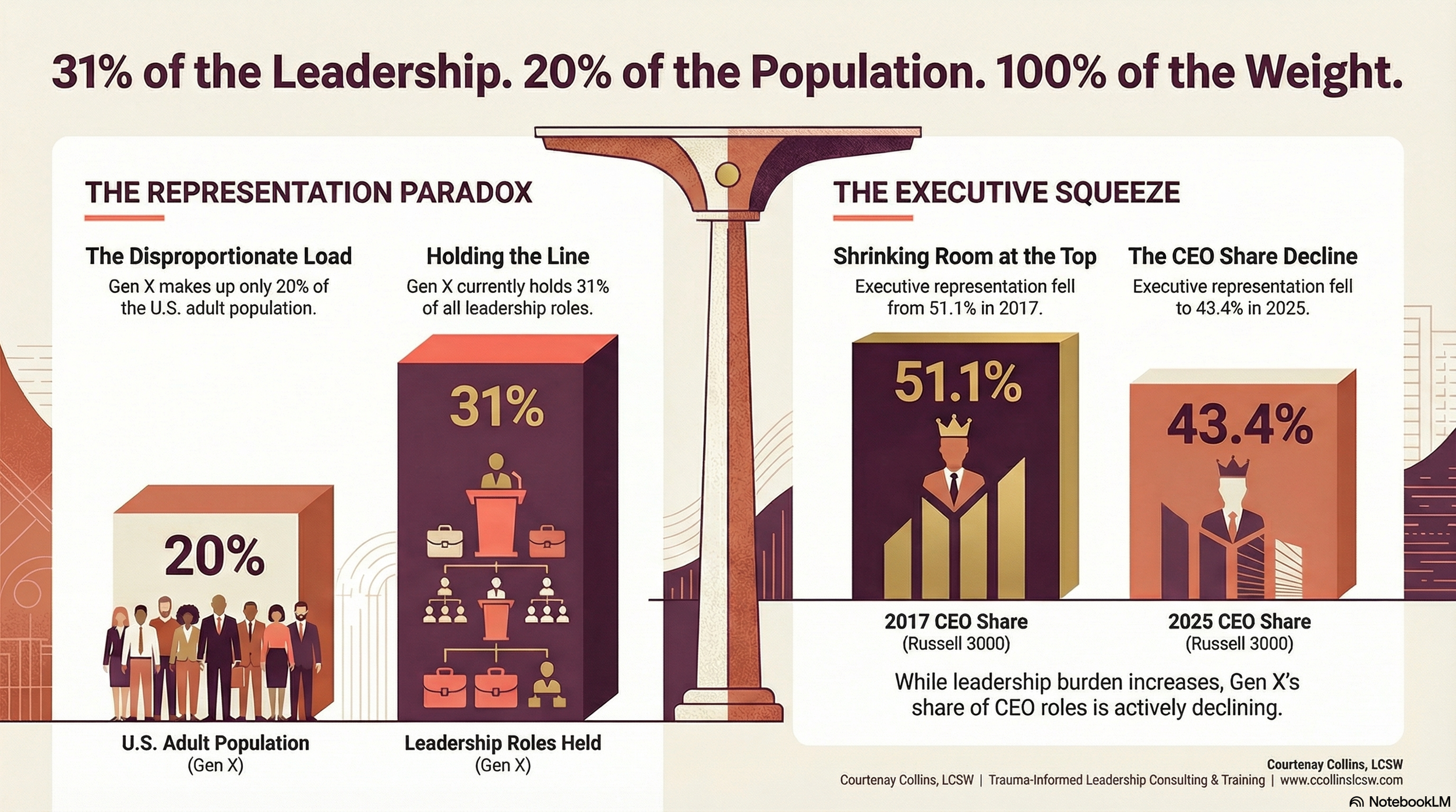
Here is a number worth sitting with: Gen X represents approximately 20% of the U.S. adult population but currently holds 31% of leadership roles, according to Solsten's 2025 generational data. That is not a sign of dominance. That is a sign of a generation doing disproportionate organizational work — again.
This is the pattern Gen X has navigated for their entire careers. Squeezed from above by Boomers who stayed in senior positions longer than previous generations, and from below by Millennials who arrived with significant institutional momentum and attention, Gen X largely carried organizational weight without receiving equivalent recognition, investment, or advancement. The Russell 3000 data tells the story plainly: Gen X's share of CEO roles declined between 2017 and 2025, even as their share of the overall leadership burden increased.
And that is before accounting for what many Gen X leaders carry outside the office. They are the sandwich generation: managing aging parents and adult children simultaneously while navigating what should be their peak career decade. The professional and the personal do not stay in separate compartments. They live in the same nervous system.
The result is a leadership cohort that is functionally carrying more than their role description captures — and has been for years. For organizations navigating this leadership moment, that reality carries a direct implication: the Gen X leader you are counting on to stabilize your culture may be doing so from a system that has not been replenished in a long time.
This is not a leadership gap. It is a nervous-system capacity gap.
Practical takeaway: Stop assessing Gen X leaders solely on output. Assess the conditions under which they are producing it. Sustainable performance requires sustainable infrastructure — and right now, most Gen X leaders are not operating with that in place.
The Shadow Side Nobody Names — Until It Shows Up in the Culture
Here is the part of this conversation that does not make it into most leadership development programs: the same experiences that build Gen X's leadership strengths also install specific, predictable patterns that — left unexamined — create significant organizational problems.
Research from the ACE Study indicates that approximately 62% of Gen X adults experienced at least one form of significant childhood adversity. The figure that matters alongside it: only around 11% ever addressed that adversity in any therapeutic context. Which means the majority of Gen X leaders navigating high-pressure organizational roles are doing so with nervous system patterns that were shaped in difficult circumstances — and have never been deliberately examined.
What does that look like in practice?
Hypervigilance is one of the most common presentations. The Gen X leader who is always reading the room, always managing the emotional temperature, always tracking whether someone is about to be upset or offended. From a distance, this looks like emotional intelligence. Up close, it is an exhausting, resource-depleting pattern of threat-scanning that leaves very little bandwidth for genuine strategic thinking or presence.
Earned distrust of institutions is another. The healthy skepticism that kept Gen X grounded in a culture of corporate loyalty theater can become — when it is running on old wiring rather than current information — an inability to delegate, trust upward, or build genuine interdependence with a team. The leader who handles everything because they do not trust anyone else to do it is not demonstrating competence. They are demonstrating an unexamined wound at scale.
And then there is the suppressed needs pattern — the "I'll figure it out myself" orientation that was adaptive in a latchkey childhood and becomes actively limiting in senior leadership. You cannot lead an organization through significant change from a position of performed self-sufficiency. Leadership at that level requires the ability to be supported, to ask for what you need, and to model that it is safe for others to do the same.
Practical takeaway: If your organization has a Gen X leader who seems to handle everything, never asks for help, and appears slightly exhausted all the time — that is not a strength to leverage. That is a warning sign to respond to.
How Unexamined Gen X Wounds Play Out Across an Entire Organization
This is the part that makes individual nervous system patterns an organizational issue: leaders do not just manage people. They regulate them.
Dr. Stephen Porges' polyvagal theory provides the framework for understanding why. Human beings are continuously and largely unconsciously scanning their environment for cues of safety or threat — and the most powerful source of those cues in any organizational setting is the person with the most authority in the room. A leader's nervous system does not stay contained to the leader. It sets the tone for every interaction, every meeting, every moment when someone is deciding whether it is safe to tell the truth or whether they should manage the information first.
A dysregulated Gen X leader — one whose unexamined hypervigilance, conflict avoidance, or "figure it out yourself" orientation is running the culture — does not produce a psychologically safe organization, regardless of how much they value psychological safety. As Courtenay Collins, LCSW, who brings 25+ years of clinical trauma expertise to this work, states directly: "The most dangerous Gen X leader isn't the one who leads like a Boomer. It's the one who has all the right values and zero regulated capacity to hold them under pressure."
The patterns show up in specific, recognizable ways.
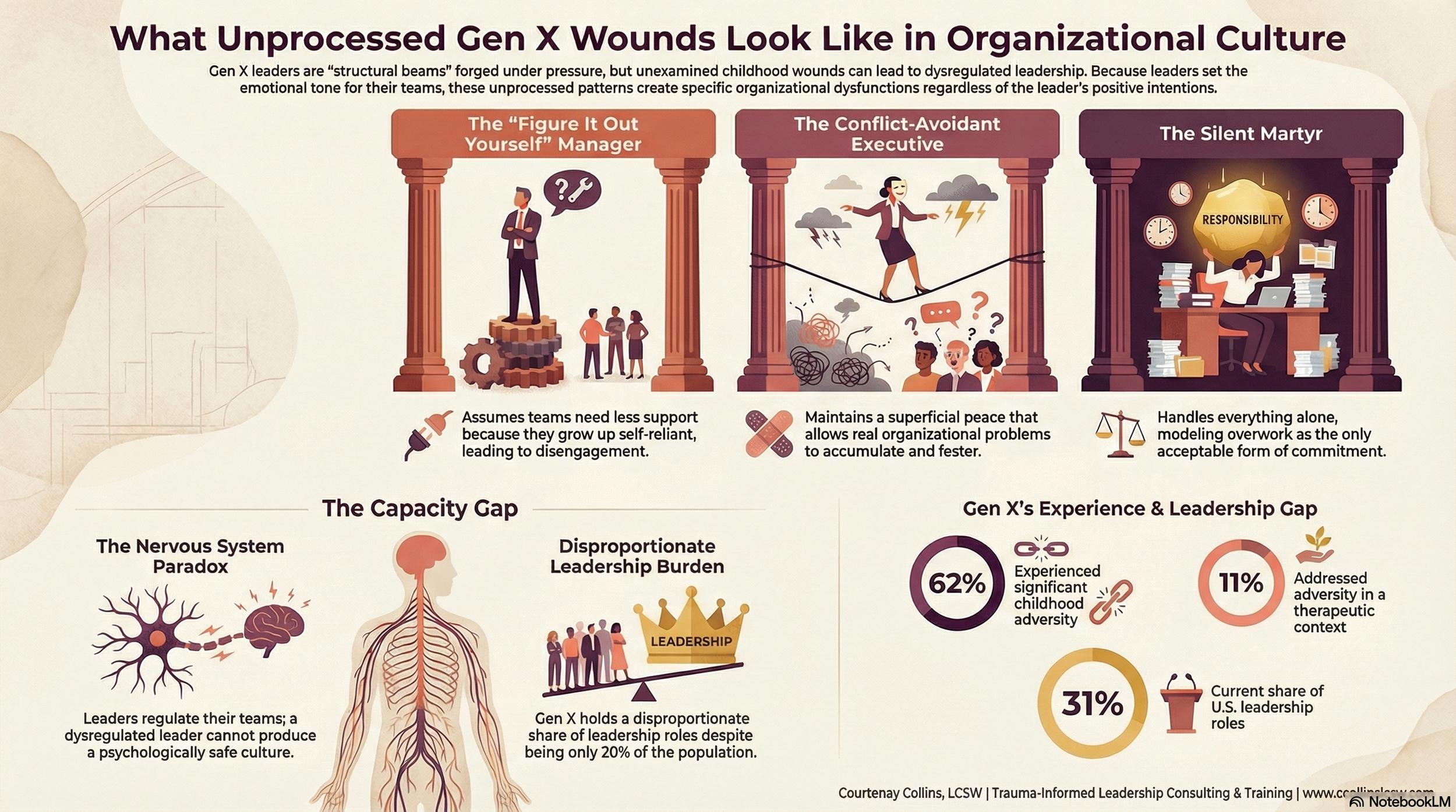
The "figure it out yourself" manager who genuinely does not realize they are recreating their own childhood — not through cruelty, but through the simple assumption that people should need less than they do. Teams under this leader become quietly under-supported and eventually disengaged.
The conflict-avoidant executive who keeps the peace at the cost of honest culture. Everyone is technically fine. Nobody is actually saying what they think. Performance looks acceptable on paper while the real problems accumulate underneath.
The leader who handles everything and burns out silently — and in doing so, models martyrdom rather than resilience. Their team learns that this is what commitment looks like. They adapt accordingly.
None of these leaders are bad people. None of them intend this outcome. But intention is not the same as capacity, and capacity is what the situation actually requires.
Practical takeaway: Before any culture initiative, leadership training program, or psychological safety effort — assess the nervous system state of the leaders who will be delivering it. Culture travels through people, not through programs.
What It Actually Takes to Build Psychological Safety When It Was Never Modeled for You
Google's Project Aristotle research identified psychological safety as the single most important factor in high-performing teams — more important than talent, resources, or strategic clarity. The research was unambiguous: without it, everything else underperforms.
What the research did not fully address is what it takes for a leader to actually build it — particularly when psychological safety was not a feature of their own formative experience.
You cannot perform your way to psychological safety. A leader can have the right language, the right policies, the right stated values — and still produce a culture in which people do not feel genuinely safe to speak honestly, make mistakes, or ask for help. Because psychological safety is not a communication strategy. It is a relational field, and it is generated by the nervous system state of the person with the most authority in the room.
Dr. Rebekah Lloyd's 2024 research on trauma-informed leadership identifies four core attributes that define leaders who can build this field reliably: authenticity, emotional intelligence, relational capacity, and resilience. These are not personality traits that leaders either have or don't. They are capacities that can be developed — and that development is precisely what most Gen X leaders have not had adequate support to do.
The critical distinction is between a Gen X leader who leads from wounding and one who leads from healed strength. The first is running their considerable capacity through unexamined patterns — using self-reliance as a substitute for support, using competence as armor, using conflict avoidance as a version of care. The second has done enough of their own work to know the difference — and to hold the room with genuine steadiness rather than performance.
That distinction is not incidental to organizational outcomes. It is the mechanism through which organizational culture either shifts or doesn't.
For Gen X women carrying this particular weight, the intersecting pressures of leadership, emotional labor, and nervous system depletion are worth naming separately. The post "Why the Fawn Response Makes You Cave on Your Boundaries" addresses what that looks like in practice — and what actually changes it.
Practical takeaway: Invest in leadership development that builds nervous system capacity, not just strategic skill. The return is not soft. It shows up in retention, in culture stability, and in the quality of decisions made under pressure.
What Organizations Need to Invest In — Before the Wall Gets Hit
Most organizations wait until a leader is visibly struggling before they respond. By that point, the cost is already significant.
Research from ELMO and Mulcahy's 2025 data on workforce replacement shows that replacing an employee can cost between six and nine months of their salary — and for senior leaders, whose tenure, institutional knowledge, and team relationships cannot be quickly replicated, the real cost runs considerably higher. That is not counting the culture disruption, the transition instability, or the burnout contagion that spreads through organizations when a leader hits the wall publicly.
The business case for investing in Gen X leader support before that point is not complicated. It is just underutilized.
What that investment looks like in practice goes beyond standard leadership development. Competency frameworks and communication skills training are useful. They are not sufficient for what is actually being asked of Gen X leaders right now — which is to hold increasingly complex organizational systems, navigate a multi-generational workforce, and do it with enough internal stability to produce psychological safety rather than erode it.
What actually moves the needle is nervous system capacity building: support that helps Gen X leaders recognize when old patterns are running, regulate under genuine pressure, build the tolerance for interpersonal risk that psychological safety requires, and access the support they need without interpreting it as failure.
This is the work Courtenay Collins, LCSW, brings to organizational consulting engagements — not performance coaching in a softer register, but the kind of grounded, evidence-based capacity building that actually changes how leaders function when the pressure is real.
Organizations that invest in this now are not being idealistic. They are being strategically precise about where their culture lives and what it costs when it fails.
Practical takeaway: Treat Gen X leadership capacity as a retention and culture infrastructure investment — not as an optional development benefit. The organizations that do will not be surprised by what happens when their best leaders finally stop holding.
The Bottom Line
Gen X did not arrive at this leadership moment unprepared. They arrived shaped by exactly the experiences that modern organizations most need: adaptability, pragmatism, low attachment to hierarchy, and a hard-won tolerance for pressure that most leadership models cannot fully replicate.
The question is not whether they are capable. They are.
The question is whether they are supported — whether the organizations that depend on their capacity are investing in its sustainability, or simply loading the beam until it fractures.
The window to answer that question well is now. The transition from Boomer command-and-control to the kind of leadership that actually produces psychologically safe, high-performing cultures is underway. Gen X can lead it. The organizations around them have to decide whether they are willing to do what it takes to make that possible.
If your organization is ready to invest in the kind of leadership development that addresses this level, explore Trauma-Informed Leadership Consulting & Training or Request a Consulting Conversation.
The capacity to lead well is not fixed. It can be built. But it has to be built — not assumed.
Gen X is carrying your organization. Are you investing in their capacity to keep doing it?
Trauma-informed leadership consulting helps Gen X leaders build the nervous system capacity to lead psychologically safe, high-performing cultures — and helps organizations stop waiting for their best people to hit the wall before they respond.
Frequently Asked Questions
What makes Gen X leadership style different from other generations?
Gen X was shaped by a distinct set of formative experiences — high autonomy, low institutional support, and for many, significant childhood adversity. Solsten's 2025 psychological data shows Gen X scores higher on Competence than any other current generation in the workforce. Their leadership style tends to be pragmatic, merit-oriented, and skeptical of hierarchy for its own sake. These are well-matched to modern organizational needs — particularly the shift toward psychological safety and flat structures. The risk is that the same patterns that build these strengths can, when unexamined, produce hypervigilance, conflict avoidance, and excessive self-reliance — all of which have direct culture costs.
Why is Gen X burnout a leadership problem, not just a personal one?
Leaders regulate their teams. This is not a metaphor — it is how nervous systems work in social settings. When a Gen X leader is running on a chronically depleted system, that state transmits through every interaction, every meeting, and every moment when someone is deciding whether it is safe to speak honestly. A burned-out leader does not produce a psychologically safe culture regardless of their stated values. Gen X currently holds approximately 31% of U.S. leadership roles while representing only 20% of the adult population. Their burnout is an organizational infrastructure issue, and organizations that treat it as a personal problem are misreading where the risk actually lives.
What is the nervous system connection to leadership?
The nervous system governs how humans process threat, build trust, make decisions under pressure, and connect with others. Dr. Stephen Porges' polyvagal theory established that human beings are continuously and largely unconsciously scanning their environment for safety or threat — and that the most powerful source of those cues in any organizational setting is the person with the most authority in the room. Leaders who are operating from a chronically activated threat response — hypervigilance, shutdown, or survival-mode self-reliance — cannot generate genuine psychological safety, regardless of their intentions or their communication skills.
How does childhood adversity affect Gen X leaders specifically?
Research from the ACE Study indicates that approximately 62% of Gen X adults experienced significant childhood adversity — yet only around 11% addressed it in any therapeutic context. The patterns produced by that adversity — hypervigilance, earned distrust of institutions, suppressed need for support — often become both the source of Gen X's leadership strengths and the mechanism of their leadership limitations. The difference between a Gen X leader who leads from wounding and one who leads from healed strength is not a matter of values. It is a matter of whether the underlying wiring has been examined and worked with.
What does trauma-informed leadership development look like in practice?
Trauma-informed leadership development goes beyond communication frameworks and strategic skill-building to address the nervous system patterns driving behavior under pressure. Drawing on Dr. Rebekah Lloyd's 2024 research, it builds four core capacities: authenticity, emotional intelligence, relational capacity, and resilience — not as concepts, but as embodied skills that leaders can access when the stakes are real. Courtenay Collins, LCSW, brings 25+ years of clinical trauma expertise to this work through organizational consulting and training. It is important to note that this consulting is educational and developmental in nature — it is not therapy and does not function as a substitute for mental health care.
What is the business case for investing in Gen X nervous system capacity?
The cost of replacing a senior leader runs between six and nine months of their salary, according to ELMO/Mulcahy 2025 workforce data — and that figure does not account for culture disruption, transition instability, or the burnout contagion that spreads when a high-profile leader hits the wall publicly. Google's Project Aristotle research identified psychological safety as the single most important factor in team performance. Both data points point to the same conclusion: investing in the regulated capacity of Gen X leaders is not a wellness initiative. It is a retention and performance strategy with a measurable return.
Is this leadership consulting or therapy, and what is the difference?
Therapy is a licensed clinical service designed to address mental health diagnosis, trauma processing, and psychological treatment, provided by licensed mental health clinicians and regulated by state licensing boards. Leadership consulting and training is educational and developmental — it is not therapy and is not a substitute for mental health care. Courtenay Collins, LCSW, offers trauma-informed organizational consulting and leadership training that draws on her clinical background to provide evidence-based frameworks for capacity building and culture change. Organizations or individuals who need mental health support should seek a licensed provider in their state.