

The Leadership Handoff Nobody Prepared For: What Happens When Boomer Command-and-Control Meets a Gen X Nervous System
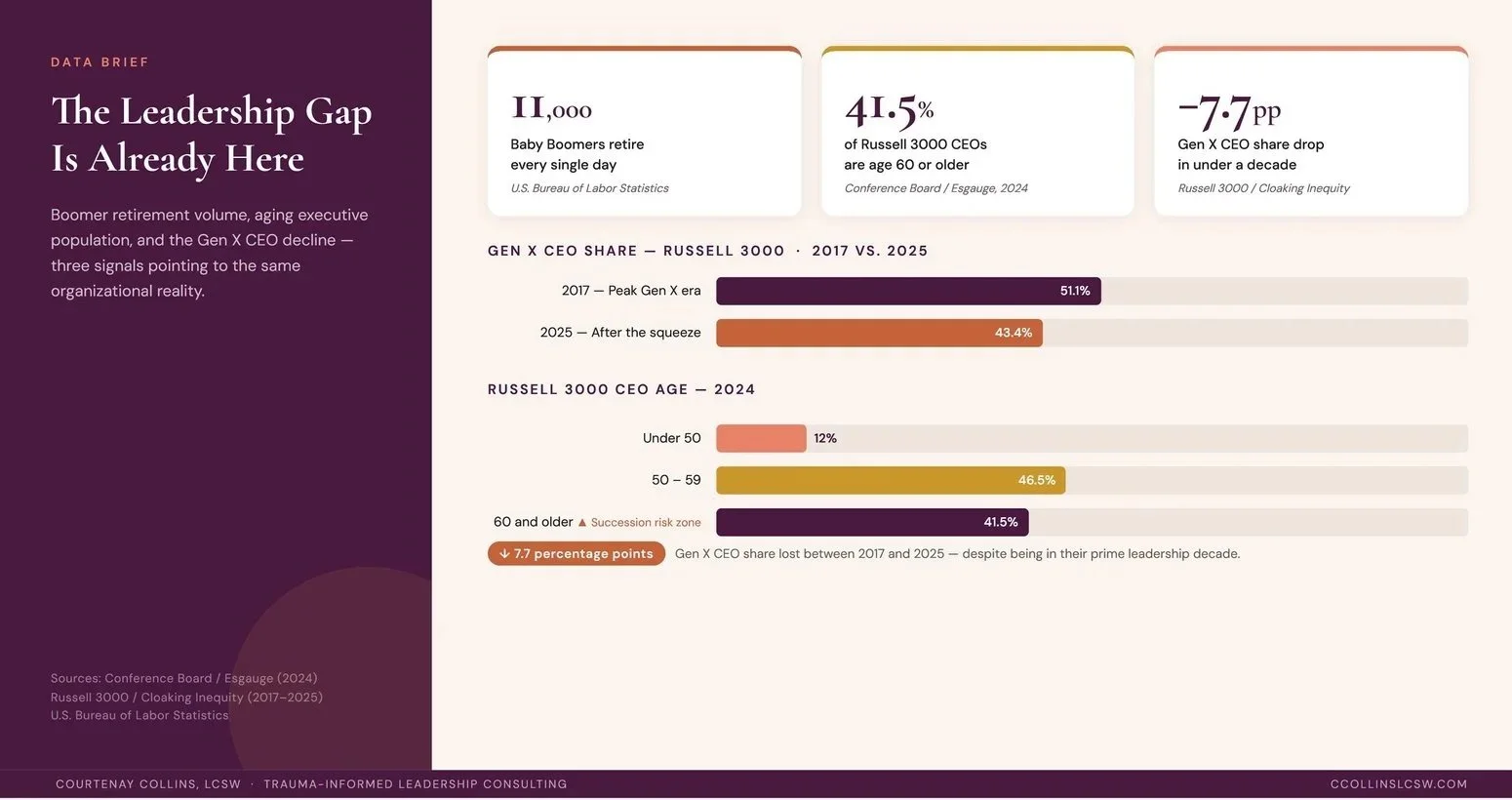
Roughly 11,000 Baby Boomers retire every single day. Most of the succession plans waiting for them address titles, reporting lines, and role responsibilities.
Not one of them addresses nervous systems.
That is the problem.
Think of a large commercial kitchen that has run on the same head chef's system for thirty years. Every station is organized around that chef's preferences. The pace, the communication style, the unspoken rules about who defers to whom — all of it has been calibrated to one person's operating style. When that chef leaves, you do not simply hand the kitchen to the next person in line and expect the culture to follow. The culture is in the walls. It is in how people brace when something goes wrong, how they read authority, what they believe will happen if they speak up.
Organizations are identical. And right now, they are in the middle of the largest nervous-system transition in modern leadership history — handing decades of command-and-control culture to a generation of leaders who were shaped, in childhood and in the workplace, by everything the previous model didn't say out loud.
This post is for the organizations and leaders trying to understand why that handoff is harder than it looks on paper — and what it actually takes to stabilize it.
This Is Not a Pipeline Problem. It Is a Nervous System Infrastructure Problem.
The numbers alone should stop most organizations in their tracks. According to Conference Board and Esgauge research, approximately 41.5% of CEOs in the Russell 3000 are at least 60 years old. The retirements already underway are not a trickle. They are a sustained organizational earthquake.
And most succession planning still treats leadership transition as a competency transfer. Find someone with the right skills. Brief them on the strategy. Hand over the login credentials.
What does not get transferred — and what almost no succession plan is designed to address — is the nervous system infrastructure the organization has been running on. The threat-and-reward wiring. The unspoken rules about status, visibility, and loyalty. The learned behaviors of everyone in the building who has spent years adapting to the leader who is now leaving.
That infrastructure does not clear itself when a new name appears on the org chart. It stays embedded in how people read authority, how they respond to conflict, and whether they believe it is safe to tell the truth. The succession plan that ignores this is not incomplete. It is a liability.
Practical takeaway: Before designing a succession plan, audit the culture — not just the competencies. Ask: what behaviors has this organization been rewarding, and what has it been punishing, for the past two decades?
How Thirty Years of Command-and-Control Gets Embedded — And Why It Doesn't Leave When the Leader Does
Baby Boomer leadership norms did not arise in a vacuum. They were shaped by the post-war economic expansion, by organizational cultures built on hierarchy, loyalty, and status as both motivator and currency. The model was clear: you earn authority by deferring to authority. You advance by proving your willingness to carry more. You lead by directing — and you expect compliance in return.
For organizations where this model ran for thirty or more years, it did not remain a leadership style. It became the architecture. It was built into performance review language, into how meetings were structured, into what got rewarded and what quietly ended careers. Research on organizational culture change consistently shows that deep culture — the assumptions and behaviors that feel like "just how things work here" — can take a decade or longer to shift, even with intentional effort.
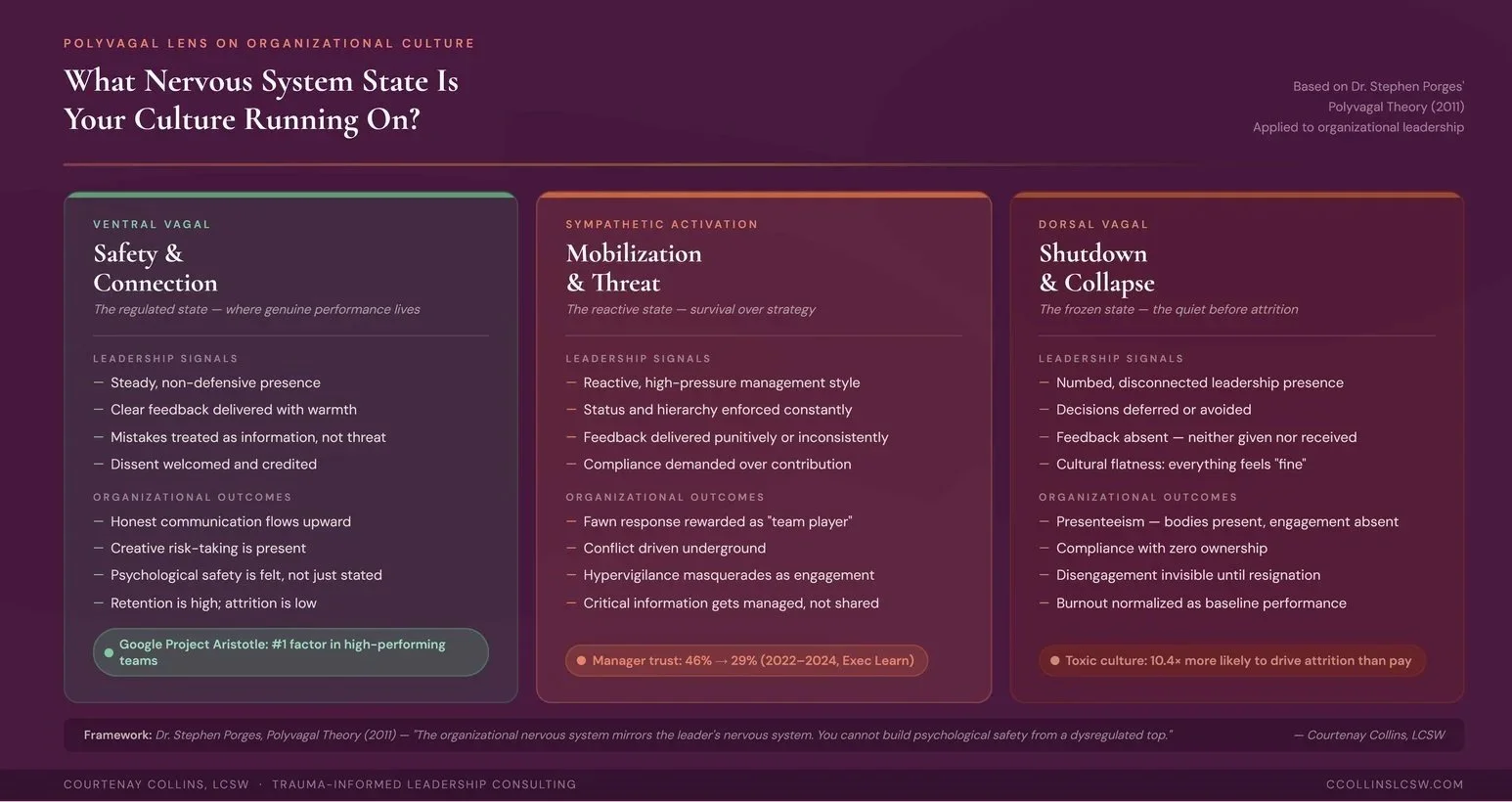
The reason this matters so much right now is that behavioral norms under threat do not simply fade. According to Dr. Stephen Porges, whose polyvagal theory provides a foundational framework for understanding safety and threat in social settings, perceived threats take individuals — and by extension, teams — offline. When a workplace has spent decades running on compliance enforced by hierarchy and status, the nervous systems inside that workplace have been trained accordingly. People have learned what happens when they push back. They have adjusted. And that adjustment does not disappear the moment a new leader walks in.
Practical takeaway: Do not assume that the departure of a command-and-control leader creates psychological safety automatically. It creates a vacuum. What fills it depends on what you build next.
What Gen X Actually Inherits — and Why Their Own Wiring Complicates the Picture
Gen X is stepping into a historically significant moment of organizational leadership. They are also the generation least likely to have been set up for it without cost.
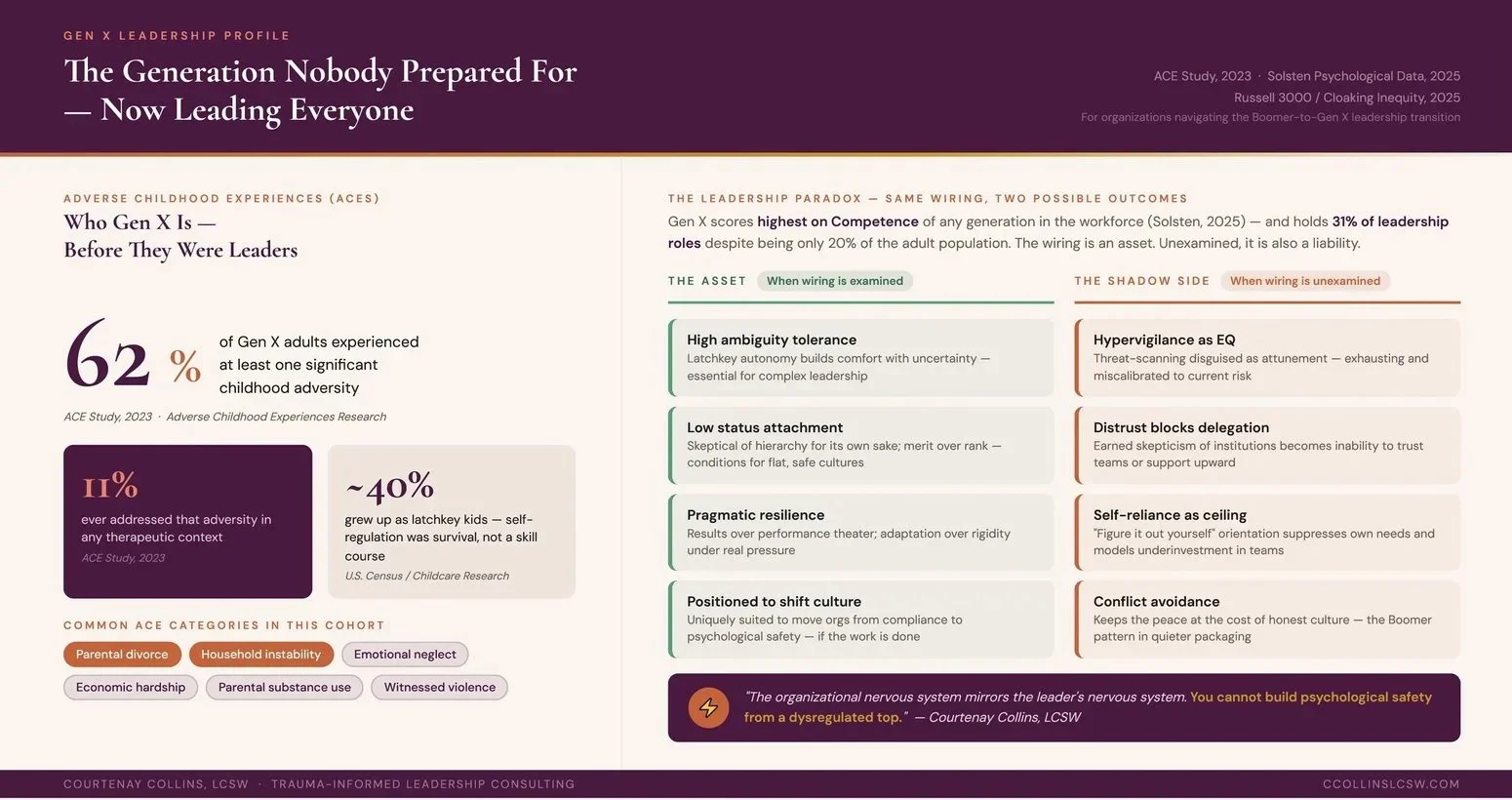
Research from the ACE (Adverse Childhood Experiences) Study indicates that approximately 62% of Gen X adults experienced at least one form of significant childhood adversity. They are the latchkey generation — raised with high autonomy, low supervision, and often high instability. What that produced, in many cases, was a particular kind of nervous system: hyper self-reliant, conflict-tolerant through avoidance, and deeply ambivalent about authority.
That wiring can be a genuine leadership asset. Gen X leaders tend to be adaptable, pragmatic, and less invested in hierarchy for its own sake. But it can also create a specific vulnerability in the organizational transition moment. When a Gen X leader inherits a culture built on compliance and status, they are not walking into neutral territory. They are walking into a system that was designed to reward the exact behaviors many of them spent their lives working around.
The result is a mismatch that rarely gets named: a generation shaped by institutional mistrust, now responsible for rebuilding institutional trust — inside organizations that were not designed with their nervous systems in mind.
As Courtenay Collins, LCSW, observes from 25+ years of clinical trauma expertise: "The organizational nervous system mirrors the leader's nervous system. You cannot build psychological safety from a dysregulated top." Gen X leaders who have not had the opportunity to examine and regulate their own patterns will inevitably replicate — in subtler form — the dynamics they inherited.
Practical takeaway: Leadership development for Gen X inheritors must go beyond strategy and communication skills. It must include nervous system literacy — the ability to recognize when past wiring is driving present decisions.
The Pressure Cooker Nobody Talked About: Why Gen X Leaders Are Already Running on Depleted Systems
Here is what rarely makes it into the leadership transition conversation: Gen X did not arrive at this moment from a position of surplus.
Data from the Russell 3000 shows that Gen X's share of CEO roles dropped from 51.1% to 43.4% between 2017 and 2025. For a generation that was supposed to be in its prime leadership decade, that is not a pipeline success story. It is evidence of a generational squeeze that has been running for their entire careers.
Gen X spent decades sandwiched between Boomer leaders who held the top positions longer than previous generations and Millennial cohorts who arrived behind them with institutional momentum and significant organizational attention. The result was a generation that was perpetually asked to hold more — more responsibility, more ambiguity, more pressure to perform — without commensurate advancement, recognition, or support.
That is a nervous system cost. It is not abstract. It shows up as leaders who are highly capable and chronically depleted. Who have learned to function at high levels under significant stress — and who may not recognize how much of their current capacity is running on fumes from years of adaptive overdrive.
For organizations navigating this transition, that reality carries a concrete implication: the Gen X leader you are promoting into a major succession role may be walking in with fewer internal resources than their competence suggests. That does not make them the wrong choice. It makes the quality of organizational support around them a strategic necessity, not a courtesy.
Practical takeaway: Leadership transitions are not just logistical. Build recovery infrastructure into the succession plan — mentorship, peer consultation, and explicit support that does not require leaders to ask for it.
The Invisible Culture: What Walks Out the Door — and What Stays Behind
When a long-tenured Boomer leader exits, organizations tend to focus on what is leaving: the institutional knowledge, the relationships, the strategic vision. What gets far less attention is what stays.
The invisible culture is the nervous system of the organization. It is the unspoken rules about who speaks first in a meeting, and what happens to the person who speaks out of turn. It is the loyalty tests — the subtle signals that tell people whether they are in or out, trusted or suspect. It is the status hierarchies that were never written down anywhere but are known by everyone. It is the way conflict gets avoided, or surfaced, or used.
This invisible culture does not leave because the leader did. In many cases, it has been reinforced across hundreds of individual interactions over decades, and it lives now in the behavior patterns of the people who remain.
From a polyvagal theory perspective, Dr. Stephen Porges' foundational work on the social nervous system clarifies why this matters: human beings are continuously — and largely unconsciously — scanning their environment for cues of safety or threat. When a workplace has been organized around hierarchical compliance, people's nervous systems have been calibrated accordingly. That calibration does not reset because the organizational chart changed.
Psychological safety — the foundation of high-performing teams, and the #1 factor identified in Google's landmark Project Aristotle research — does not emerge by default when a new leader arrives. It is built, deliberately and consistently, through the signals a leader sends about what is acceptable, what is encouraged, and what will genuinely not result in punishment.
Practical takeaway: In the first 90 days of a leadership transition, the most important communication is not strategic. It is behavioral. What a new leader does under pressure — how they respond to dissent, mistakes, and difficult information — sets the nervous system tone for the entire organization.
What Trauma-Informed Leadership Actually Looks Like as a Response
The phrase "trauma-informed leadership" gets used in a lot of ways. Here is what it means in practice for organizations navigating this particular transition.
Dr. Rebekah Lloyd's 2024 research on trauma-informed leadership identifies four core attributes that distinguish leaders who stabilize organizations during periods of significant change: authenticity, emotional intelligence, relational capacity, and resilience. These are not personality traits. They are capacities — which means they can be developed, and which means the absence of them can be addressed.
What those attributes produce, in practice, is a leader who does not need compliance to feel in control. Who can hold space for uncertainty without defaulting to top-down pressure. Who can be wrong in front of their team without interpreting it as a threat. Who can recognize when an employee's behavior is stress-driven rather than performance-driven — and respond to the right thing.
This is the opportunity inside the Boomer-to-Gen X transition, and it is a significant one. Gen X leaders — especially those who have done their own work — are often genuinely suited to this style. They are not naturally drawn to hierarchy. They have lived through enough institutional disappointment to be skeptical of performance over substance. They tend to respect competence over status. Those are exactly the qualities an organization needs to shift from a compliance-based culture to a psychologically safe one.
But — and this is what Courtenay Collins, LCSW, addresses directly in her trauma-informed organizational consulting work — this shift does not happen because a leader intends it. It happens because leaders and organizations build the specific capacity to sustain it under pressure. Good intentions and a better management philosophy are not enough when the culture is still running on old nervous system wiring.
Practical takeaway: Invest in leadership development that builds nervous system literacy alongside strategic capacity. The organizations that come out of this transition intact will be the ones that treated culture stabilization as a core function — not an afterthought.
The Bottom Line
The Boomer-to-Gen X leadership transition is being described in most organizations as a management style shift. It is considerably more than that.
It is a generational handoff of organizational nervous systems — the accumulated wiring of how thousands of people have learned to read authority, manage threat, and perform under pressure. That does not transfer through succession plans, onboarding documents, or leadership frameworks alone.
What stabilizes organizations through this transition is the same thing that stabilizes individuals navigating significant change: the capacity to build genuine safety in the room, to recognize and regulate threat responses rather than amplifying them, and to lead from a place that does not require other people's compliance to function.
Gen X has what it takes to lead this moment well. The question is whether the organizations around them — and the leaders themselves — are willing to invest in the infrastructure that makes it possible.
If your organization is navigating a leadership transition and the culture feels more fragile than the org chart suggests, that instinct is worth taking seriously. Explore Trauma-Informed Leadership Consulting & Training or Request a Consulting Conversation to begin the conversation.
Your succession plan addresses the title. It may not address the culture.
The most significant leadership transitions are nervous system transitions — and most organizations are not designed to navigate them. Trauma-informed leadership consulting helps you stabilize culture, develop your next generation of leaders, and build the psychological safety your people need to actually perform.
Frequently Asked Questions
What is the baby boomer to Gen X leadership transition and why does it matter now?
Roughly 11,000 Boomers retire every day in the United States, and a significant share of senior organizational leadership is in the process of turning over to Gen X. This is the largest generational leadership shift in modern organizational history. It matters because leadership transitions are not just personnel changes — they are culture changes. The norms, unspoken rules, and nervous system patterns embedded under long-tenured Boomer leadership do not automatically clear when those leaders retire. Organizations that do not plan for the invisible culture alongside the visible structure tend to experience significant instability in the transition period.
Why is Gen X leadership style different from Boomer leadership?
Gen X was shaped by a markedly different set of formative experiences than Boomers. Research from the ACE Study indicates that approximately 62% of Gen X adults experienced significant childhood adversity — and the latchkey generation's defining traits include high self-reliance, ambivalence about institutional authority, and conflict tolerance through avoidance. In the workplace, Gen X leaders tend to be less attached to hierarchy for its own sake, more pragmatic, and more comfortable with autonomy. These are genuine strengths — but they also represent a significant culture shift for organizations that have been running on deference, status, and top-down compliance for decades.
What does "organizational nervous system" mean in the context of leadership transitions?
The organizational nervous system is a way of describing the collective patterns of safety and threat response that develop over time in a workplace. When a leader runs a command-and-control culture for an extended period, the people in that organization learn — largely unconsciously — how to read authority, manage conflict, and assess risk. Those learned patterns persist even when the leader changes. Drawing on Dr. Stephen Porges' polyvagal theory, clinicians and consultants who work in this area understand that perceived threat in a workplace takes teams offline — reducing cognitive capacity, creative thinking, and willingness to speak honestly — in ways that show up as performance and culture problems rather than what they actually are: nervous system responses.
How does psychological safety connect to the Boomer-to-Gen X leadership handoff?
Psychological safety — the belief that it is safe to take interpersonal risks, share honest information, and admit mistakes without fear of punishment — is the single most important factor in team performance, according to Google's Project Aristotle research. It is also precisely what is most likely to have been eroded under decades of command-and-control leadership. The handoff to Gen X leadership does not automatically restore it. Building psychological safety is a deliberate, behavioral, and sustained process — which means it must be planned for as part of any serious succession strategy.
Why are Gen X leaders already burned out before they fully step into senior roles?
Gen X has spent their careers squeezed between two generations with outsized organizational presence. Boomers held senior positions longer than previous generations, and Millennials arrived with significant institutional momentum. Russell 3000 data shows that Gen X's share of CEO roles actually declined between 2017 and 2025, despite being in their prime leadership decade. The result is a generation that has carried disproportionate organizational weight — often without commensurate advancement, recognition, or institutional support. Many Gen X leaders arriving at senior roles are doing so with depleted internal resources, which makes the quality of organizational support around them a strategic factor, not just a management preference.
What is trauma-informed leadership, and how is it different from standard leadership development?
Trauma-informed leadership is an approach that integrates understanding of how stress, adversity, and threat responses shape behavior — both in individual leaders and in organizational culture. It goes beyond communication skills and strategic frameworks to address the nervous system patterns that drive behavior under pressure. Courtenay Collins, LCSW, brings 25+ years of clinical trauma expertise to this work in organizational settings. It is important to note that leadership consulting and training is educational and developmental in nature and is not therapy or a substitute for mental health care. For organizations experiencing culture instability, conflict escalation, or burnout-related retention issues, trauma-informed consulting addresses the level where the actual problem lives.
Is this consulting or therapy? What is the difference?
Therapy is a licensed clinical service designed to address mental health diagnosis, trauma processing, and psychological treatment. It is provided by licensed clinicians and is regulated by state licensing boards. Consulting and leadership training is educational and developmental — it is not therapy and does not function as a substitute for mental health care. Courtenay Collins, LCSW, offers trauma-informed leadership consulting and training to organizations, drawing on her clinical background to provide grounded, evidence-based frameworks for leadership development and culture change. This is not a clinical service. Organizations or individuals who need mental health support should seek a licensed provider in their state.