

If the burnout framework your organization is using — or the one you have been applying to yourself — does not account for female biology, it is missing more than half the picture. It’s one more thing we need to rethink the more we learn about women’s bodies, brains and hormones.
That is not hyperbole. The foundational stress research that produced the fight-or-flight model, the cortisol spike, the performance decline, the standard recovery recommendations — the majority of it was conducted on male subjects. The APA did not require female subjects in NIH-funded research until 1993. (I gotta insert the eye roll.) The framework organizations have been using to identify, address, and recover from burnout was built on male nervous-system data and applied universally — which means that for decades, what women's burnout actually looks like has been misread as attitude, over-sensitivity, or insufficient resilience.
After 25+ years of working with high-capacity women, here is what I know: when High-Q women understand the biology underneath their burnout, they stop diagnosing it as a character flaw and start treating it as a system problem that has a system solution. The wrong biological framework is misapplied. That's the problem..
The Research Was Built on Men — and That Is Still a Problem
Walter Cannon's fight-or-flight model — the foundational framework for understanding how humans respond to stress — was developed through experiments conducted almost entirely on male animals and male human subjects. The stress research that built on it maintained the same subject composition for decades. The physiological stress response that organizations and clinicians have been treating as universal is, in important ways, specifically male.
Women are 49% more likely to have elevated cortisol levels than men — a difference that has significant implications for how chronic stress accumulates, how burnout develops, and what recovery actually requires. Yet the clinical and organizational frameworks for addressing burnout were developed without this data as a foundational input.
Dr. Shelley Taylor, UCLA psychologist and one of the foremost researchers on gender differences in stress response, named this problem directly in her foundational research: the stress biology that produced our standard models was derived from populations that did not include women — and the behavioral, hormonal, and neurological differences between male and female stress response are clinically significant enough to require distinct frameworks.
The practical consequence for High-Q women is this: you have likely been evaluated, diagnosed, and given recovery recommendations based on a model that was not built for your nervous system. Your burnout may have been invisible to everyone around you — including yourself — because the signals it produces do not match the male-derived picture of what burnout is supposed to look like. The fact that it’s invisible even to yourself can cause guilt and shame based on some characteristic you think you like. You can’t put furniture together if you’re looking at the instructions for the Instant Pot. You have the wrong information you are not a wrong person.
Practical takeaway: If the burnout framework you are using does not account for female biology, it is not a neutral framework. It is a male framework applied universally — and it will consistently fail to see what it is looking for in women's nervous systems.
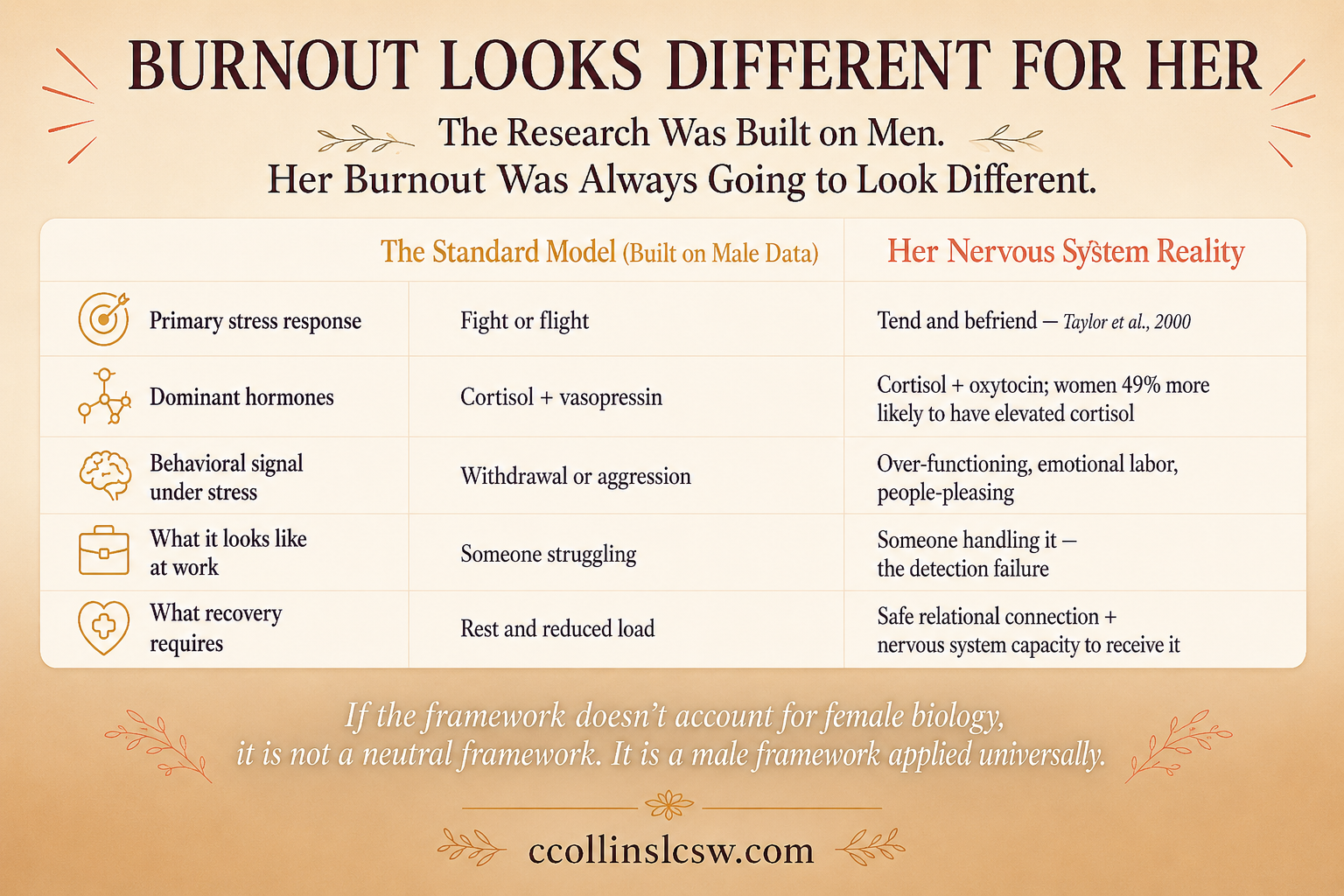
There a different stress responses between men and women. So the response in the brain and managing the nervous system requires different interventions.
Her Stress Response Has a Different Name
In 2000, Dr. Shelley Taylor and colleagues published a landmark paper in Psychological Review that proposed a fundamentally different behavioral stress response for women: tend-and-befriend.
While the physiological stress response — the cortisol spike, the sympathetic activation — occurs in both sexes, the behavioral pattern it produces differs significantly. Men under stress tend toward fight-or-flight: withdrawal, confrontation, or disengagement. Women under stress are neurobiologically primed toward tending to others and seeking social connection — driven by oxytocin and estrogen rather than vasopressin and testosterone.
This is not a social or cultural pattern. It is a measurable hormonal and neurological one. Under stress, women's bodies are producing oxytocin in ways that buffer the cortisol response and orient behavior toward relational engagement — toward smoothing, toward caring, toward maintaining connection. The tend-and-befriend response is adaptive under acute stress. It is the mechanism by which women historically protected children and built coalition under threat.
The organizational cost of this biology is specific and significant: in a stressful workplace, a High-Q woman does not disengage the way a burned-out man does.
She absorbs more. She smooths more relational friction. She tends to everyone else's nervous system while hers goes further into deficit. She picks up the emotional labor that is dropping around her. She manages the temperature of the room. She does the invisible relational infrastructure that keeps the team functional — and she does all of it more intensively precisely when she is most depleted, because her stress response is oriented toward others rather than away from them.
This is why the burnout presentations organizations are trained to detect — flat disengagement, reduced output, withdrawal — are specifically the wrong signals to be watching for in women. The burned-out High-Q woman is not disengaging. She is over-functioning. She is still showing up. She looks, to every available metric, like she is handling it.
In this post we are talking mostly about female burnout symptoms in a professional environment. I think the tend-and-befriend is definitley seen in hostile work environment when that one guy doesn’t do enough or say enough to be reported but your nervous systems knows and is freaking out. Women who have been in emotionally, physically or psychological unsafe home situations really fall in to the tend-and-befriend. It’s a deeper version of fawning.
My body started screaming at me in pain when she finally realized I was ready to accept it was time to get out of my last marriage. And when the tending stopped, boy was their s shift. When we start to understand what we need to manage burnout and we stopped tending unhealthy relationship dynamics become more and more clear. And this is with women and men who we are tending and befriending
For more on how this pattern plays out in boundary collapse and people-pleasing, Why the Fawn Response Makes You Cave on Your Boundaries covers the nervous system mechanism underneath it.
Practical takeaway: Tend-and-befriend under chronic stress looks like over-functioning, emotional labor, and people-pleasing — not the flat disengagement that leaders and clinicians are trained to recognize as burnout. The woman who looks most capable of handling it may be furthest along the burnout continuum.
What Estrogen Is Actually Doing to Her Stress System
Estrogen is not only a reproductive hormone. It is a neurological one — and it plays a direct role in regulating the stress response.
Estrogen modulates the amygdala, the brain's primary threat-detection center, and directly influences HPA axis reactivity. In premenopausal women, estrogen generally buffers stress reactivity — providing a neurochemical cushion that moderates the amygdala's response to threat and supports faster recovery from stress activation. Women are also significantly more susceptible to social stressors specifically — team conflict, perceived rejection, relational uncertainty — because the amygdala's response to those particular triggers is modulated by estrogen in ways that are distinct from the threat-response to physical danger.
As estrogen fluctuates and declines through perimenopause and menopause — typically between ages 40 and 55, which overlaps almost exactly with the peak career decade for High-Q women — that buffering effect weakens. The same relational stressors that were manageable at 35 land harder at 47. The same organizational environment that was navigable in her 30s produces a qualitatively different nervous system response in her late 40s — not because she has gotten weaker, but because the neurochemical cushion has thinned. This is not a flaw in the design. Personally. this is the time when enter our sage era as we navigate “crap” we just don’t have the energy to deal with, again.
NIH clinical research on estradiol and stress reactivity documents this relationship clearly: the HPA axis becomes more reactive as estrogen declines, producing stronger and more prolonged cortisol responses to the same stressors. Combined with the already-elevated baseline cortisol documented in women generally, this means that High-Q women in their peak career decade are operating with a nervous system that is more reactive to stress, slower to recover, and running a higher baseline activation than the standard burnout model has any framework to account for.
Perimenopause, in this context, is not just a wild bouquet of moods and hormonal nuisance to be managed. It is a significant nervous system transition happening in the middle of the highest-stakes decade of a woman's professional life — and most organizations have no framework for it whatsoever. The woman who was navigating her workload with relative equanimity at 38 is not failing at 48. Her neurochemistry changed. The model being used to assess her did not.
Practical takeaway: Perimenopause is a nervous system transition. Organizations that have no framework for it are routinely misreading the presentations it produces in their most experienced female leaders.
Why High-Q Women Are the Last Ones Anyone Worries About
High-Q women are specifically vulnerable to late-stage burnout detection for the same reason they are so valuable to organizations: the tend-and-befriend wiring means that under pressure, they functionally perform better at the interpersonal and emotional labor that makes organizations run.
The competence trap closes like this: as stress increases, the High-Q woman's nervous system produces more relational engagement, more smoothing, more absorbing of friction. She picks up what is dropping. She manages the emotional temperature. She continues to deliver. From every external metric available, she is handling it — better, in many ways, than her male counterparts, who are more likely to show disengagement early.
Meanwhile, her HPA axis has been running on chronic activation. The cortisol load is accumulating. The estrogen buffering is thinning. The nervous system is in a sustained state of hyperactivation without adequate recovery. And the organization, seeing her continued high performance on visible metrics, has no signal that anything requires attention.
McKinsey and LeanIn.org's Women in the Workplace research places 60% of senior-level women reporting frequent burnout — the highest level ever recorded. That is not a data point about women's insufficient resilience (oh, I could get on a soapbox with this one.) It is a data point about the compounding cost of a stress response that orients toward others, operating in environments that have built their functioning on the labor that response produces, without any structural provision for the recovery it requires.
The woman who looks most capable of handling it may be furthest along the burnout continuum. That is not a contradiction. It is the predictable output of a nervous system whose adaptive response to stress is invisible to detection systems calibrated for the male model.
For a direct look at what this looks like in organizational contexts, Burnout Does Not Always Look Like Burnout covers the presentations that most organizations are missing.
Practical takeaway: In High-Q women, the burnout that is furthest along is most likely to be invisible - but she’s also the one who feels like she can never rest, even when there is time. The detection systems calibrated to catch male burnout presentations are systematically missing the population most at risk.
The Recovery She Needs Isn't What the Research Prescribed for Him
Standard burnout recovery recommendations — rest, reduced workload, time off, solo decompression — were developed from male stress biology. They are necessary but not sufficient for women's nervous system recovery, and in some cases they are actively counterproductive.
Because the tend-and-befriend system is fundamentally relational, women's nervous systems recover most effectively through genuine safe connection — not isolation. The oxytocin that is central to the female stress response is also the neurochemical most associated with genuine relational safety. It is safe co-regulation. It is released through physical touch, through being heard, through the specific neurological experience of being in the presence of someone safe who is not requiring anything of you.
Dr. Taylor and colleagues' research on social support and women's stress response demonstrates that social support from other women specifically — not just any social contact, but genuine, safe, mutual connection with other women — downregulates women's physiological stress responses more effectively than equivalent support from men or solo rest. Proof we NEED girl’s nights.
The mechanism is biological: the social engagement system, activated by genuine connection, produces the ventral vagal states that allow the sympathetic nervous system's threat-response to finally disengage. You know, this is the science of why girl’s night or just those two trustworthy friends sharing a bottle of wine always seems to make you feel better.
For High-Q women, this creates a specific and frequently unaddressed recovery challenge: the women who are most depleted are also the ones whose relational lives have been most organized around giving rather than receiving. They are the ones other people come to. They are the ones who tend when things are hard. The genuine reciprocal safe connection that their nervous systems most need for recovery is often precisely what they have least access to — because the same tend-and-befriend wiring that produced the burnout has also structured their relationships in ways that make genuine receiving difficult.
Recovery for High-Q women is not a spa weekend. It is rebuilding the capacity to receive support without immediately redirecting it to someone else — which is nervous system work, not just scheduling work. It is finding relational contexts that do not require performance or management. It is building the specific kind of connection that produces genuine ventral vagal rest.
When I worked as a psychotherapist with a full case load, I purposefully took 4 day weekends every quarter to get away with the love of my life who has learned how to hold the space. There is no performance and no transactional obligations. Just reading, talking, walking, and you know all the other stuff. You can co-regulate with friends, partners, your dog, or even singing with others at a concert or church service.
If you are ready to do this work with support designed for how you are actually built, explore Coaching for High-Capacity Women or learn more about Burnout Boundaries Breakthrough.
Practical takeaway: Recovery for High-Q women requires genuine safe relational connection — the biological antidote to the tend-and-befriend stress response. Solo rest is necessary but not sufficient. The women most depleted are often the ones who have organized their lives around giving, and rebuilding the capacity to receive is itself part of the recovery.
The Bottom Line
Her biology is not the problem. Her biology was never designed to fail — it was designed for a different context than the one she is operating in, and it has been measured by a framework that was not designed for it - the perfomance reviews are designed by men for men. Not all the metrics to see if you deserve a raise are on that assessment. Most of the time NONE of the things measured all you do are taken into account.
The stress response that orients her toward others under pressure is not weakness. The elevated cortisol reactivity is not fragility. The neurochemical shifts of perimenopause are not decline. These are specific, measurable features of a distinct neurological architecture that organizations and clinicians have been misreading — as attitude, as over-sensitivity, as insufficient resilience — because the model they were using was built on someone else's nervous system data.
When a High-Q woman understands what her nervous system is actually doing — why she over-functions under stress rather than withdrawing, why the relational stressors land harder in her 40s than they did at 35, why the standard recovery recommendations leave her still depleted — she stops diagnosing herself as the problem. She starts making different decisions. And those decisions, made from accurate information rather than from the accumulated shame of a framework that was never designed for her, ripple outward.
Heal one woman without burnout, and she changes companies, communities, and culture. That is where we are headed. I want to teach you the transformational things you can do to change where you work but your home and family too.
Support women leading collaboratively, and the world shifts. That is not aspiration. It is the biological downstream of finally giving women the right framework for understanding their own nervous systems.
Your burnout is a system problem. It has a system solution.
Coaching for High-Capacity Women is designed for the specific nervous system architecture you are actually working with — not the male-derived model that has been misreading your burnout as a character flaw.
Frequently Asked Questions
Why do women burn out differently than men?
Because the female stress response is neurobiologically distinct from the male one. Women's behavioral stress response — the tend-and-befriend pattern described by Dr. Shelley Taylor — is driven by oxytocin and estrogen rather than vasopressin and testosterone. Under stress, women are oriented toward relational engagement rather than withdrawal or confrontation. This means that burnout in women typically presents as over-functioning, sustained emotional labor, and apparent high performance rather than the flat disengagement that male-derived burnout frameworks are calibrated to detect. The biology is different. The presentations are different. The recovery requirements are different.
What is the tend-and-befriend response?
Tend-and-befriend is the female behavioral stress response first named by Dr. Shelley Taylor and colleagues in a landmark 2000 paper in Psychological Review. While fight-or-flight describes the physiological stress activation that occurs in both sexes, it describes a specifically male behavioral pattern. Under stress, women are neurobiologically primed toward caring for others and seeking social connection — driven by the release of oxytocin alongside cortisol. In high-stress professional environments, this produces the over-functioning, emotional labor, and people-pleasing that most organizations read as handling it rather than as burnout.
How does estrogen affect burnout in women?
Estrogen modulates the amygdala — the brain's threat-detection center — and directly influences HPA axis reactivity. In premenopausal women, estrogen provides a neurochemical buffer that moderates the stress response. As estrogen fluctuates and declines through perimenopause and menopause, that buffering effect weakens, and the HPA axis becomes more reactive to the same stressors. This means that the relational and organizational stressors that were manageable at 35 may produce qualitatively stronger and more prolonged nervous system responses at 47 — not because something has gone wrong, but because the neurochemical conditions have changed.
Why are High-Q women the hardest burnout cases to detect?
Because their stress response produces behaviors that look like competence. The tend-and-befriend wiring means that under pressure, High-Q women increase their relational engagement, absorb more organizational friction, and continue to deliver on visible metrics — right up until the HPA axis has been running on chronic activation long enough that the system begins to break down. The burnout presentations organizations are trained to detect — disengagement, flat affect, reduced output — are specifically the wrong signals to watch for. The woman furthest along the burnout continuum is often the one who looks most capable of handling it.
What does recovery actually look like for women with burnout?
Because the tend-and-befriend system is relational, women's nervous systems recover most effectively through genuine safe connection — not solo rest or isolation. Research by Dr. Shelley Taylor and colleagues shows that social support from other women specifically downregulates women's physiological stress responses more effectively than support from men or solo rest. The neurochemical mechanism is oxytocin released through genuine relational safety, which activates the ventral vagal states that allow the sympathetic threat-response to disengage. For High-Q women whose relational lives have been organized around giving, the specific recovery challenge is rebuilding the capacity to receive support without immediately redirecting it — which is nervous system work, not scheduling work.
What is the difference between therapy and coaching for women's burnout?
Therapy is the appropriate support for processing the accumulated cost of chronic burnout — the relational patterns, attachment history, and specific experiences that shaped the over-functioning — and for working through what the burnout has cost over time. Coaching is educational and developmental: it builds the nervous system capacity, practical structures, and identity ground for actually living differently — for holding limits, receiving support, and building a life that does not require continuous output as its organizing principle. Courtenay Collins, LCSW, offers trauma-informed coaching grounded in 25+ years of clinical expertise. Both levels of support are often relevant. The intake process is the right place to assess which fits.
DISCLAIMER: Courtenay Collins is a psychotherapist turned trauma-informed coach. This program is educational and coaching-based, not therapy or a substitute for psychotherapy, diagnosis, or mental health treatment.