

Burnout Does Not Always Look Like Burnout — And That Is Why Leaders Keep Missing It
You are looking for someone who cannot function anymore. That’s what most leadership thinks burnout looks like.
But burnout at work rarely announces itself that way.
Think of a slow gas leak. You cannot see it, smell it at first, or point to the moment it started. But the air in the building is changing. People are shorter with each other. Decisions take longer. The team that used to recover fast is not recovering. The manager who used to be steady is now reactive. Something is wrong, but no one has named it yet — and by the time they do, the damage is already expensive.
That is how workplace burnout operates in most organizations. Not as a sudden collapse, but as a slow, behavioral shift that gets misread as attitude, performance, or personnel problems — until it becomes a retention crisis.
In this post, you will learn what workplace burnout actually looks like before it becomes obvious, why leaders consistently misread the early signals, and what trauma-informed leadership does differently to interrupt the pattern before the cost compounds.
The WHO Definition Changes the Whole Picture
Before we talk about what burnout looks like, it helps to be precise about what it is.
The World Health Organization classifies burnout as an occupational phenomenon — not a medical diagnosis — resulting from chronic workplace stress that has not been successfully managed. Its three markers are exhaustion, increased mental distance or cynicism toward the job, and reduced professional efficacy.
Read that again. Two of those three markers are behavioral and relational, not physical. Cynicism. Distance. Reduced efficacy. None of those show up on a sick day report. All of them show up in meeting rooms, one-on-ones, and team dynamics — often months before anyone names what they are looking at.
This is the clinical reframe that matters most: burnout is not primarily an energy problem. It is a chronic stress problem that progressively reshapes how people think, communicate, and relate. As Courtenay Collins, LCSW, with 25+ years of clinical trauma expertise explains, the organizations that catch burnout early are the ones that stop looking for the person who has collapsed and start looking for the system that is quietly collapsing people. This is about learning how to take care of your caretakes. This is in every industry from pest control companies to fire departments.
Burnout has a nervous system solution. And it’s a solution mangers and leaders can use to shift company culture, improve personal wellness through neurological biohacks and reduce burnout and staff turnover. It save money.
A 2024 survey found that 52% of employees reported feeling burned out — and burned-out employees are three times more likely to seek a new job.High 5 Test By the time that search is active, the cost of replacement is already in motion.
Practical takeaway: If you are only looking for exhaustion, you are looking at the wrong symptom. Cynicism, withdrawal, and reduced follow-through are earlier and more common signals.
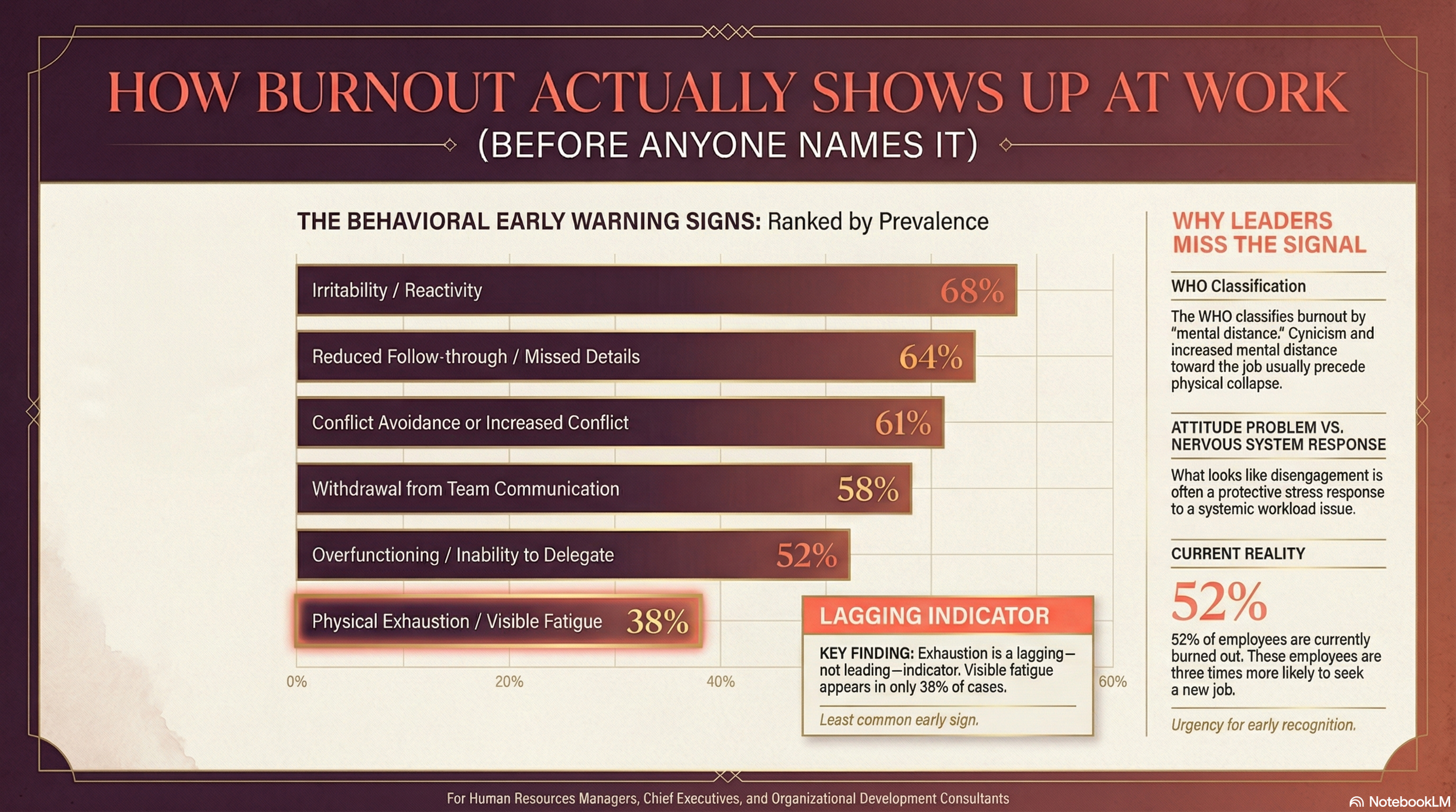
What Workplace Burnout Actually Looks Like — Before Anyone Names It
Here is what chronic workplace stress looks like in practice, inside real organizations, before it becomes a formal concern.
It looks like a high performer who has gotten noticeably harder to reach. A manager who used to give clear feedback and now avoids hard conversations entirely. A team that meets every deadline but has stopped generating new ideas. People doing the exact minimum to get through the day — and doing it with a smile that does not reach their eyes. It looks like quiet quitting.
It can also look like the opposite: overfunctioning. Staff who are absorbing more than their share, solving problems that are not theirs to solve, and carrying invisible labor that no one has named as labor. These are often the last people a leader worries about, right up until the moment they quietly hand in their notice. Invisible labor is real and has a cost for the person carrying it. Most often women in any role, not just management or leadership, are overfunctioning and carrying the invisible labor of the team.
Around 82% of white-collar knowledge workers in a 2024 DHR Global survey reported being at least slightly burned out — the highest level on record.HR Brew That figure includes the people in your organization who look fine on paper.
Christina Maslach, professor emerita of psychology at UC Berkeley and co-creator of the Maslach Burnout Inventory — the most widely used burnout assessment tool in the world — has identified six workplace mismatches that predict burnout: overload, lack of control, insufficient reward, community breakdown, unfairness, and values conflict. Not one of those mismatches shows up in a performance review as "burnout." All of them show up as the behaviors leaders misread every day.
Practical takeaway: Review recent performance concerns for signs of overload, role confusion, chronic urgency, or emotionally costly team dynamics. The behavior you are managing may be a symptom of a system problem, not a people problem. The evaluation of these issues are also overheard in conversations or nonverbal communication regarding one person or another. It’s not always indicated on a formal performance review. Listen and look at your managers and the team, it can be observed.
Why Managers Are Where Burnout Concentrates First
Burnout is not evenly distributed across an organization. It tends to accumulate fastest in the middle.
Managers absorb pressure from above and below simultaneously. They translate strategic change into daily operations, carry the emotional weight of their team, manage conflict they did not create, and maintain performance under expectations that frequently shift. They are also, in most organizations, the least likely to be asked how they are actually doing. THese mid level leaders are part of the caretakers group. In community based organizations these people are team leaders, case managers, and other types who manage the clients and the caseload.
A 2025 Cariloop report found that 82% of managers reported feeling burned out — a higher rate than entry-level employees at 73%.Cariloop That gap matters because the effect does not stay contained at the management level. Often the burnout behaviors of the managers trickle down to the entry-level employees or new hires.
Gallup's State of the Global Workplace 2025 report found that global employee engagement fell to 21% in 2024 — matching the lowest levels recorded since the pandemic — at a cost of $438 billion in lost productivity.Inclusion Geeks The same research consistently shows that the manager relationship is the strongest driver of team-level engagement and burnout risk. When managers are depleted, dysregulated, or checked out, that state transmits directly into team culture, communication quality, and psychological safety.
And when any human doesn’t feel safe, the autonomic nervous system kicks in to help achieve a feeling of safety. Due to this physiological response, it’s often hard for a person to identify what is happening except to use words like stressed, overwhelmed or burntout.
This is one of the most important things I see in organizational consulting work: by the time a leader calls about a team culture problem, the manager at the center of it has usually been running on empty for six months or more. The team is reacting to what the manager is no longer able to give.
Practical takeaway: Do not survey staff broadly and assume you are measuring your organization accurately. Look specifically at manager strain, role clarity, and expectation load. Manager burnout is a leading indicator, not a lagging one.
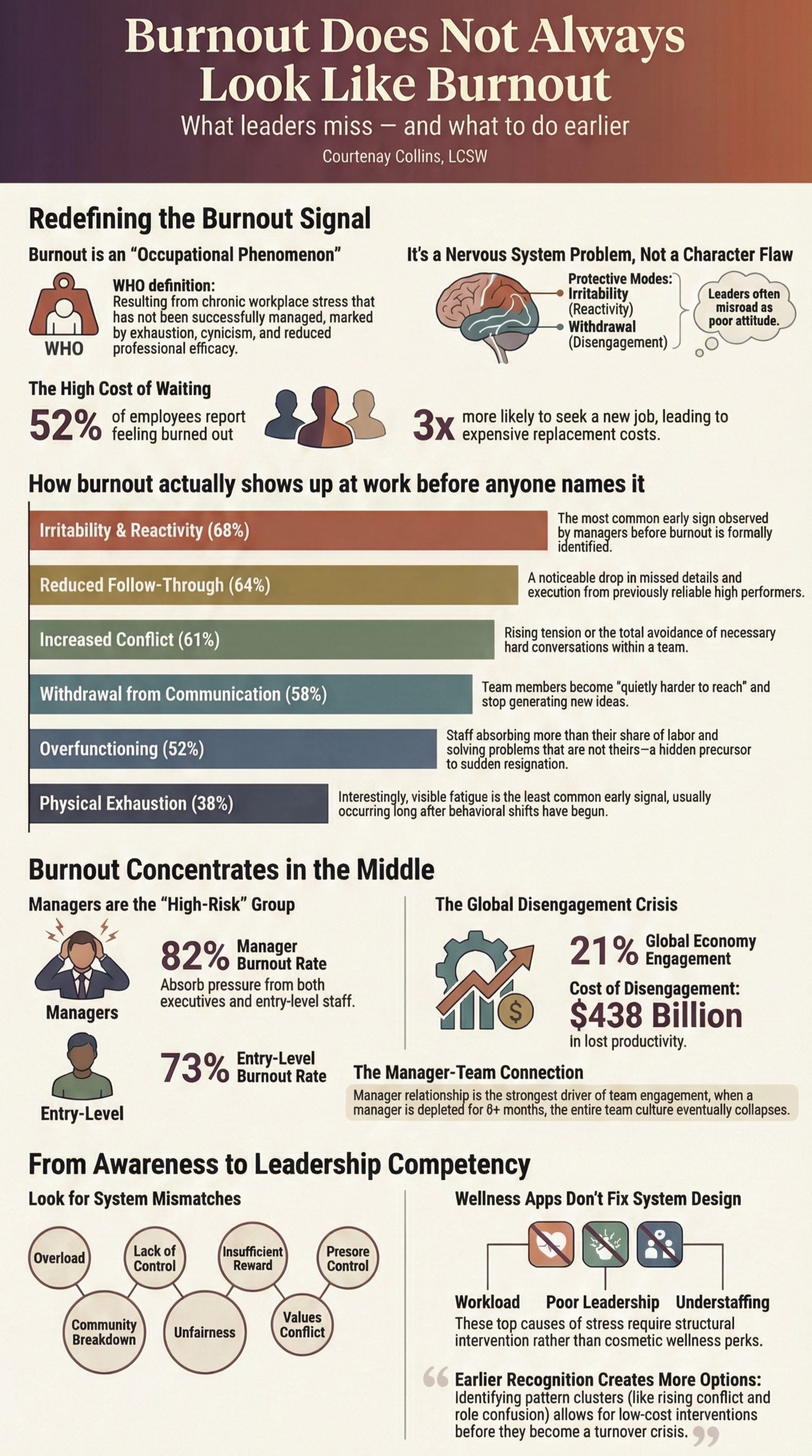
What Looks Like an Attitude Problem Is Often a Nervous System Problem
This is where trauma-informed leadership becomes operationally useful — not as a wellness philosophy, but as a practical lens for understanding what stress does to behavior.
Under sustained pressure, the human nervous system shifts into protective modes. Depending on the person and the pattern, that can show up as irritability and reactivity, conflict avoidance and flatness, micromanaging and over-control, or a quiet withdrawal that reads as disengagement. None of these are character flaws. All of them are recognizable stress responses — and all of them have direct consequences for team communication, decision quality, and culture.
The U.S. Surgeon General's 2022 Framework for Workplace Mental Health and Well-Being identifies five essentials of a healthy workplace: protection from harm, connection and community, work-life harmony, mattering at work, and opportunity for growth. These are not soft perks. They are the conditions under which a nervous system can stay regulated enough to function well. When they are absent, the behaviors that follow look like attitude problems to leaders who do not have a framework for what they are actually seeing. It’s important to be inquistive about this when you notice it. Especially, if you don’t want to lose your better employees.
Gallup's 2024 State of the Global Workplace found that 41% of employees worldwide reported feeling a lot of stress on a daily basis. Wellhub Employees in toxic workplace climates were found to be eight times more likely to experience burnout. That is not a wellness number. That is an operational risk number.
Leaders who understand what chronic stress does to the nervous system become significantly less likely to moralize what they are observing — and significantly more able to intervene in ways that actually change something. That shift alone reduces unnecessary escalation and speeds recovery. This is the core of trauma-informed leadership consulting and training: not softening the standard, but understanding what is actually driving the behavior before responding to it.
Practical takeaway: When tone shifts, conflict rises, or previously reliable people become harder to reach, slow down before making a character judgment. Ask what the pressure pattern is doing to the system first. Ask compassionate questions.
Why Wellness Perks Do Not Fix Burnout Generated by Leadership and System Design
A lot of organizations are still trying to solve a structural problem with a cosmetic intervention.
They add a wellness app. They send a reminder about unused PTO. They bring in a speaker for Mental Health Month. They launch a resilience initiative. None of that is worthless. But none of it reaches the source if the daily culture is still running on chronic urgency, unclear priorities, inconsistent leadership behavior, and invisible overfunctioning that no one has named or addressed.
Workers in a 2025 Wellhub survey cited workload, poor leadership, and understaffing as the top three causes of workplace stress. Those are not problems a mindfulness app can touch. They are problems of system design and leadership behavior — and they require a different level of intervention.
Researcher and organizational psychologist Amy Edmondson of Harvard Business School, whose work on psychological safety and team performance has shaped how leading organizations approach culture and retention, distinguishes between surface-level culture fixes and structural ones. Her research consistently shows that teams perform better and sustain that performance longer when they operate in environments where the daily experience of work does not require constant self-protection.
Burnout prevention is not a benefit. It is a leadership and culture strategy. When organizations treat it as the former, they keep spending money on solutions that do not reach the actual problem — and their retention numbers show it.
Practical takeaway: Before investing in another morale initiative, identify which leadership habits, system patterns, or workload structures are generating the drain in the first place. Address those first.
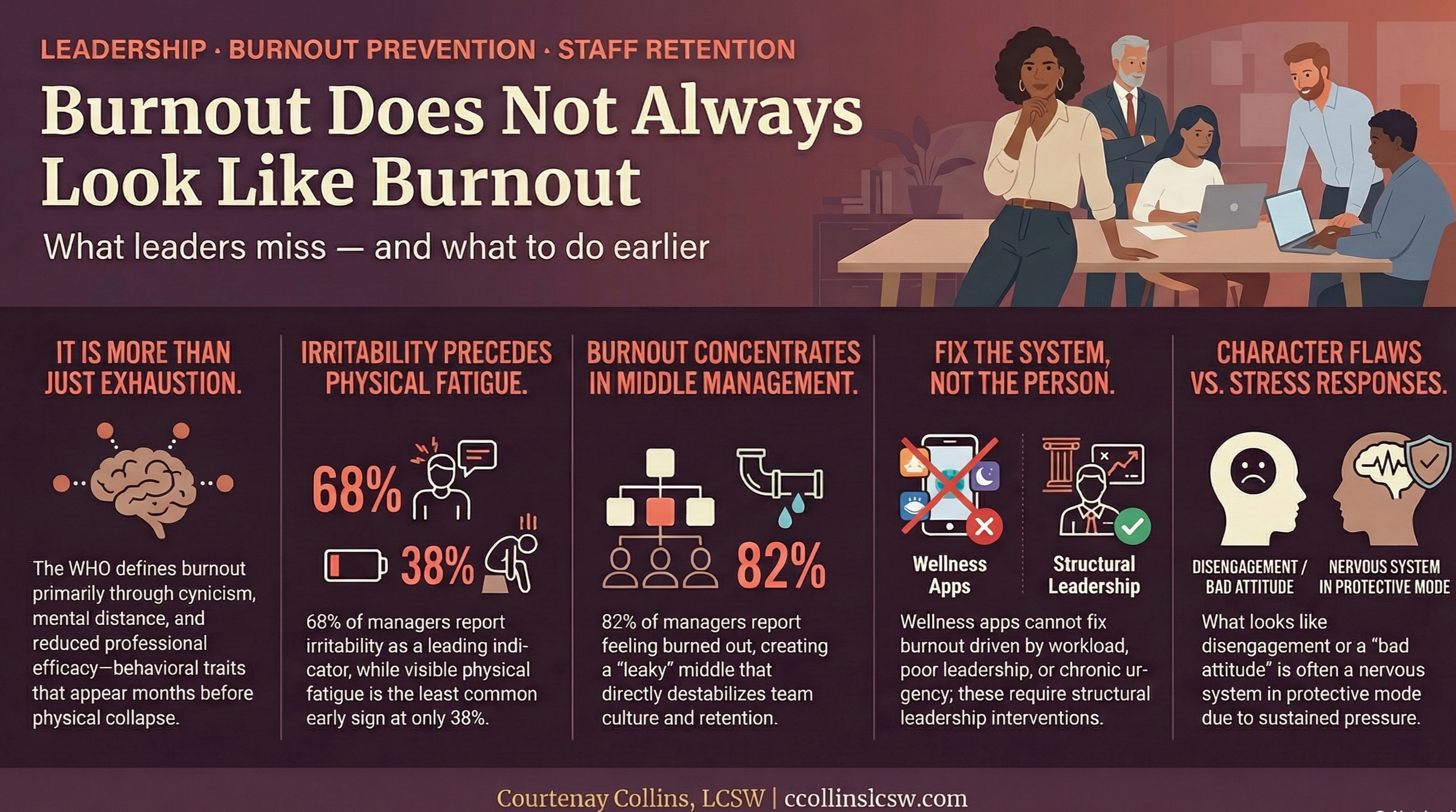
Bar chart comparing manager burnout rates at 82% versus entry-level employees at 73%, alongside global engagement at 21%, showing how burnout concentrates in middle management
Earlier Recognition Creates More Options
The most expensive version of burnout is the version that gets addressed after it has already become a turnover and culture crisis.
By that point, organizations are managing the consequences: strained managers, lower trust, damaged team dynamics, recruitment costs, and reduced performance from the people who stayed. The window for lower-cost intervention — role clarity conversations, workload rebalancing, leadership behavior coaching, communication structure — has already closed.
Earlier recognition changes the math entirely. Estimates show that disengagement tied to burnout can cost a 1,000-person organization up to $5 million annually in absenteeism, turnover, and lost productivity. That is not a wellness budget line. That is a business continuity number — and it shifts the conversation about requesting a consulting conversation from optional to strategic.
The pattern clusters that signal burnout before it becomes acute are consistent: more conflict, lower patience, role confusion, manager strain, and quiet withdrawal from previously reliable people. These are not unrelated personnel issues. They are the visible edge of chronic organizational stress — and they are readable if you know what you are looking at.
The goal is not to make the workplace softer. It is to make performance sustainable. Those are not the same thing, and the organizations that understand the difference are the ones that retain their best people.
Practical takeaway: Track pattern clusters, not isolated incidents. When you see multiple people in the same team or reporting line becoming shorter, less clear, or less effective at the same time, look at the system they are embedded in.
The Bottom Line
If you are only looking for the person who cannot get out of bed, you will miss workplace burnout until it is a retention problem.
At work, burnout almost always arrives as something else first: irritability that gets labeled attitude, withdrawal that gets labeled disengagement, reduced efficacy that gets labeled a performance problem. Those are the same syndrome at different stages of progression — and the earlier you can name the pattern, the more options you have before the cost compounds.
Trauma-informed leadership is not about asking less of people. It is about understanding what chronic stress does to performance and culture, and building the leadership capacity to respond to that reality before it becomes a crisis.
If your organization is seeing the early signals — manager strain, rising conflict, quiet disengagement, or accelerating turnover — explore trauma-informed leadership consulting and training orrequest a consulting conversation to assess what your workplace is actually reacting to.
Healthier performance does not come from asking people to push harder. It comes from removing what is steadily draining them.
Frequently Asked Questions
What are the early signs of burnout at work that leaders often miss?
The most commonly missed signs are behavioral and relational rather than physical: irritability, detachment, reduced patience, avoidance of hard conversations, slower or lower-quality decisions, and a team that has stopped recovering between demanding cycles. The WHO's definition of burnout includes cynicism and reduced professional efficacy as core markers — both of which show up in culture long before visible exhaustion does. Leaders trained to look only for collapse will miss the earlier, more actionable signals.
Why does workplace burnout show up as a performance problem first?
Because chronic stress changes how people think, communicate, and relate before it changes whether they can function at all. Under sustained pressure, the nervous system shifts toward protective responses — reactivity, avoidance, flatness, or over-control — that look like attitude or engagement problems to leaders without a stress framework. By the time performance metrics drop, the behavioral signals have usually been present for months. Addressing the surface symptom without the underlying cause is why so many performance improvement efforts fail to stick.
Why are managers the highest-risk group for burnout in organizations?
Managers absorb pressure from multiple directions simultaneously — strategic demands from above, team needs from below — while maintaining their own performance. A 2025 Cariloop report found that 82% of managers report burnout, a higher rate than entry-level employees. Because Gallup research consistently shows that manager engagement and behavior drive approximately 70% of team-level engagement variance, burnout that concentrates in management does not stay there. It spreads outward into team culture, psychological safety, and retention.
What is trauma-informed leadership and why does it help with burnout prevention?
Trauma-informed leadership is a framework that applies an understanding of how chronic stress and adverse experiences shape behavior, communication, and performance. Rather than moralizing what leaders observe — labeling reactive behavior as bad attitude, or withdrawal as lack of motivation — trauma-informed leaders ask what pressure pattern is generating the response. This produces earlier, more accurate diagnosis of organizational stress and more effective intervention strategies. It is not a wellness philosophy. It is a practical lens for understanding what is actually driving culture and performance outcomes.
Do wellness programs actually prevent workplace burnout?
Only if they address the sources of burnout rather than just supporting recovery from it. Research consistently shows that the primary drivers of workplace burnout are workload, poor leadership, and understaffing — none of which a wellness app or mental health speaker can reach. Organizations that reduce burnout sustainably do so by changing leadership behavior, clarifying roles and expectations, and redesigning the workload structures that are generating chronic stress. Wellness benefits support that effort but cannot substitute for it.
What is the difference between consulting and therapy for organizational burnout?
Therapy is a licensed clinical service that addresses individual mental health treatment and diagnosis. Consulting is educational and organizational in nature — it focuses on leadership behavior, system design, communication structures, and culture patterns, not individual clinical care. Courtenay Collins, LCSW, brings 25+ years of clinical trauma expertise to organizational consulting — meaning the framework is clinically informed — but the work itself is consulting, not therapy. If employees need individual mental health support, they should be referred to licensed providers in their state.
How early can organizations realistically detect burnout before it becomes a retention problem?
Significantly earlier than most do. The behavioral and relational signals — manager reactivity, team withdrawal, rising conflict, role confusion, and reduced output quality — typically precede formal attrition by three to six months or more. Organizations that conduct regular leadership health checks, assess manager strain alongside staff surveys, and treat pattern clusters as early warning data rather than isolated incidents create a meaningful window for lower-cost intervention. The gap between early detection and late detection is often the difference between a culture conversation and a turnover crisis
Coaching and intensive programs are educational and developmental in nature and are not psychotherapy or a substitute for mental health diagnosis or treatment. If you need mental health care, please seek a licensed provider in your state.