

Why the Fawn Response Makes You Cave on Your Boundaries — Even When You Know Better
You know the script. Keep it short. Don't overexplain. Just say no.
I often use the acronym JADE. I originally heard it from Al-Anon rooms. JADE means you don’t Justify, Argue, Defend or Explain. It is a great concept. However, when I am stressed out or edging toward burnout those four little letters never cross my mind.
And then a moment arrives, you have every intention to stick to your boundaries and keep the promise you made to yourself — and something else entirely happens.
Picture a circuit breaker. When too much voltage runs through the system at once, the breaker doesn't malfunction. It does exactly what it was designed to do: it trips. It shuts the current down to protect everything connected to it.
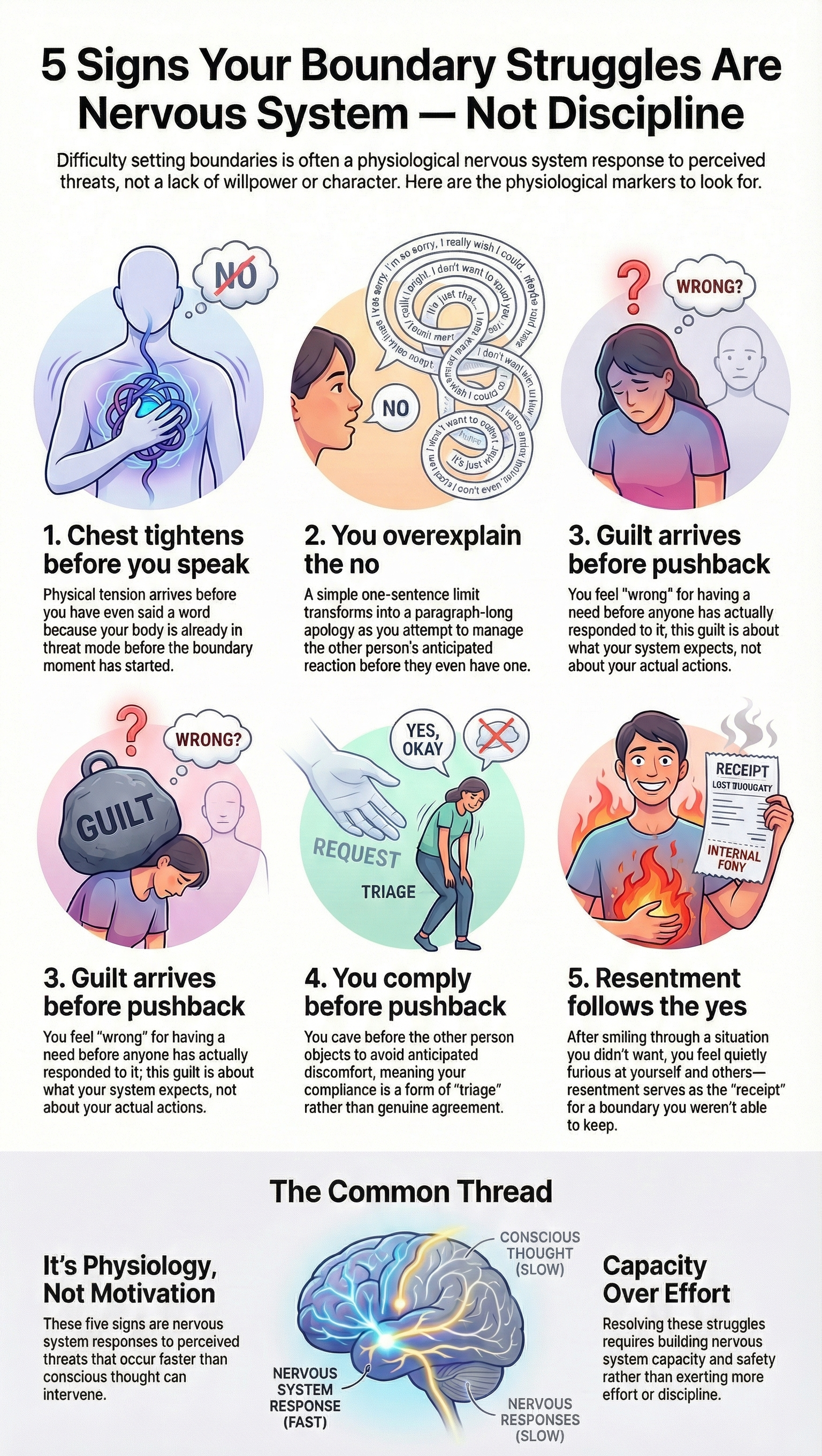
Your nervous system works the same way. When a boundary moment carries enough relational charge — disappointment, conflict, someone's frustration aimed at you — your body doesn't consult your values or your journal. It runs a threat calculation that happens faster than thought. And if the system decides that holding your limit is more dangerous than letting it go, the breaker trips.
That is not weakness. That is not a character flaw. That is a nervous system doing its job — based on old wiring that may no longer serve you. This is your brain working exactly how it was designed to so that feel safe.
In this post, I'm going to walk you through why "just say no" keeps failing for high-capacity women, what the fawn response actually is and why it gets mistaken for kindness or flexibility, and what it genuinely takes to build boundaries that hold under pressure — not just in calm moments.You Don't Have a Willpower Problem. You Have a Wiring Problem.
Here is what I see most often with the women I work with: they are not confused about all their boundaries. They know exactly what or who they want to say no to. However, there are certain people, situations or circumstatnces when the boundaries fail. The gap is not intellectual. It is physiological.
Under stress, your body shifts into protective modes that can change your breathing, your heart rate, your muscle tension, even your speech. You may start a conversation with complete clarity — and find yourself agreeing to something you didn't want, mid-sentence, before you even know what happened.
This is what researchers and clinicians call state-dependent functioning. The version of you who can hold a limit cleanly is available — but she requires a certain nervous-system state to show up. When threat signals are high enough, a different version takes over. Not a weaker one. A more survival-oriented one. And this threshold is different for everyone. There isn’t a script that will apply to everyone. This is why we have to consider you as a whole person. Both physiology, psychology and experience must be recognized and managed.
According to APA Stress in America data, women report an average stress level of 5.3 out of 10 compared to 4.8 for men — and nearly a third of women rated their current stress an 8 or higher, compared to just 21% of men. That is not a backdrop. That is the operating condition inside which your boundary moments are happening.
Practical takeaway: The next time you collapse a boundary, resist the urge to diagnose your character. Ask instead: what was my nervous system protecting just now? Take stock of the who, what, and where these boundary struggles happen. It will give you some insight.
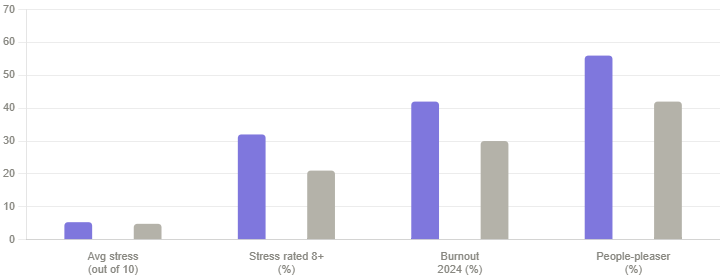
Women carry a heavier stress load — and it shows up in boundary moments
Source: APA Stress in America & 2024 Workplace Data
Average stress score (out of 10): women 5.3, men 4.8 — APA Stress in America. Women reporting stress level of 8+: 32% vs 21% of men. Female burnout rate 2024: 42% (up 4 pts); male burnout rate: 30% (down 3 pts) — State of Workplace Burnout 2024. Women identifying as people-pleasers: 56% vs 42% of men — YouGov. Women - Purple | Men - Gray
The Fawn Response: What It Is and Why It Gets Mistaken for Kindness
Most people have heard of fight, flight, and freeze. Fewer have heard of the fourth stress response — and it is the one that shows up most often in the boundary moments of high-capacity women.
The fawn response was first named by therapist and complex PTSD specialist Pete Walker to describe a survival strategy rooted in appeasement. As Walker described it, fawn types seek safety by merging with the wishes, needs, and demands of others — acting as if the price of admission to any relationship is the forfeiture of all their needs, rights, and boundaries.
Rather than confronting or fleeing a threat, the fawn response turns inward: we try to stay safe by becoming pleasing, helpful, or agreeable. The logic is: if I can stay likable enough, maybe I won't be hurt.
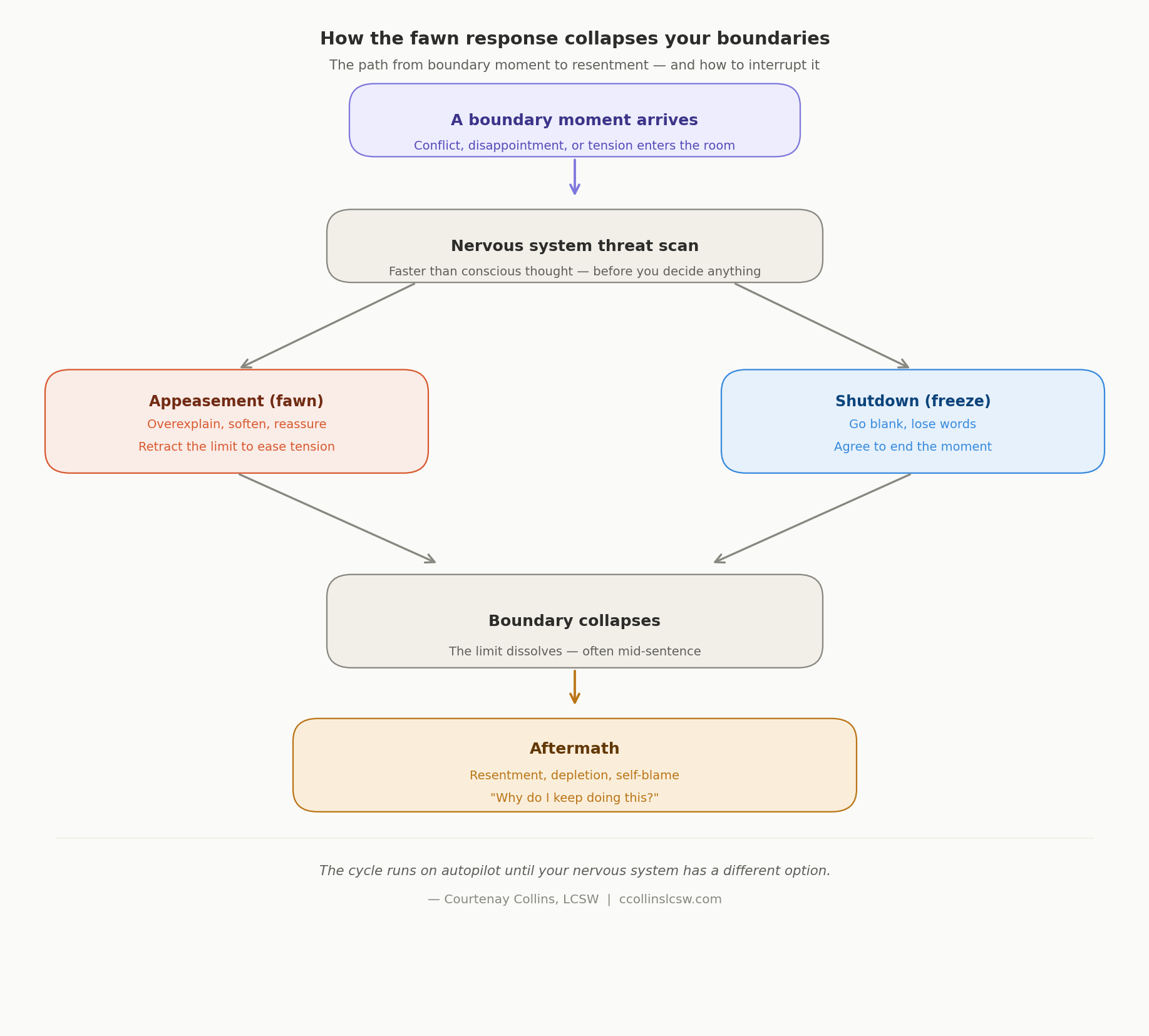
In practice, it looks like this: overexplaining a simple no until the other person feels fine and your limit has dissolved. Softening a request so thoroughly it stops being a request. Agreeing quickly because the tension in the room feels physically unbearable.
This may seem even more familiar when you put it in context of unwanted sexual advances. When threatened in this way a lot of us have been taught or learned, by default, just be nice. The logic is if I am nice enough or pleasing enough I won’t get attacked or harrassed. This is another highly occuring fawn response.
From a polyvagal theory perspective — developed by neuroscientist Stephen Porges — the fawn response is understood as a blend of the social engagement system and the dorsal shutdown system. You are engaging with others, but from a place of collapse or fear rather than genuine safety. You are there, and you are functioning. But you are not really choosing. You are surviving.
Here is the part that matters most: this pattern is especially easy to misread in high-capacity women. From the outside, it looks like flexibility, warmth, or professionalism. On the inside, it is often fear.
Practical takeaway: The next time you catch yourself overexplaining or backpedaling on something you meant, ask — was that a choice, or was that the fawn response buying safety? Or the next time you find yourself giving into sexual activity that you would rather not do ask yourself what is keeping you from feeling safe?
Make it stand out
Whatever it is, the way you tell your story online can make all the difference.
Why High-Capacity Women Are the Most Vulnerable to Boundary Collapse
The women who struggle most persistently with boundary collapse are not the least capable. They are often the most adaptable — and that adaptability has been reinforced at every turn.
A YouGov survey found that 56% of women identify as people-pleasers compared to 42% of men — and among women who self-identify this way, 47% say the pattern has made their life harder. The disparity is not random. Women are socialized from an early age to prioritize others' comfort, manage the emotional temperature of a room, and stay agreeable even at personal cost. This seems to run higher in southern culture and in chuch culture. It’s not necessarily openly taught, however, it a clear expectation communicated at every opportunity by men, leaders, and other women.
When that socialization meets a high-achiever's drive to perform and deliver, the result is a woman who is exceptionally good at carrying pressure. The problem is that being able to carry something does not mean it belongs to you.
The competency trap closes like this: the more reliably you absorb the extra load, the more load gets handed to you. Over time, your nervous system learns that keeping the peace and staying useful is how connection — and sometimes safety — gets maintained. Holding a boundary starts to feel like a threat to the relationship. Caving starts to feel like the smart, mature, generous move. Even when you are quietly resentful and completely depleted.
Literally, your brain is taking over to protect you from something that feels unsafe. Notice my wording, “feels” unsafe. The part of your brain that makes that decision does not base it in logic, facts or even reality. It is responding to if you feel safe or if you feel unsafe. This is not a cop out - it’s neuroscience.
This is what I mean when I describe the women I work with as not bad at boundaries — highly capable and exhausted. The capacity is real. So is the cost.
Practical takeaway: Look at where your competence has quietly become consent. The fact that you can carry it does not mean you were supposed to. And is it really consent if what you are seeking is the feeling of safety?
Two Ways Boundary Collapse Shows Up Under Stress — and Neither One Is Random
Most women I work with assume their boundary problem is inconsistency. It is almost never random. Boundary collapse under stress tends to run in one of two predictable directions.
The first is appeasement — smoothing, fixing, reassuring, cushioning the other person's reaction before it even fully arrives. This looks like a three-paragraph explanation for a one-sentence no. It looks like retracting a limit the moment someone's face changes. It looks like taking responsibility for someone else's disappointment. I see this most often as the high-performers professional response.
The second is shutdown — going blank, losing words, agreeing because the body simply has no energy left to hold the line. This is understood as a protective shutdown rather than relaxation — it can show up as disconnection, brain fog, difficulty making decisions, and a heavy, weighted-down exhaustion. You are not being indecisive. Your system is out of resources. Shutdown is seen a lot in personal relationships with high-capacity women because they have already done so much appeasing.
What makes this particularly disorienting is that you may be fully articulate and clear in low-stakes contexts — in your journal, in therapy, with safe people — and then lose access to that clarity in precisely the relationship where you need it most. That is not hypocrisy. That is the nervous system responding to cues that signal risk. That is when you feel unsafe.
Practical takeaway: Track your pattern. Do you tend to appease and over-explain, or go blank and agree fast? Specific patterns are far easier to identify. You can start by considering how you feel when you know you’re going to meet a certain person or you have to have a certain type of conversation with someone.
Emotional Labor Is Real Labor — and It Is Already Overloading Your System
Before the boundary moment even arrives, something else is already happening in the bodies of most high-capacity women: they are managing the emotional atmosphere of every room they are in.
Tracking whether someone is upset. Adjusting their tone before anyone asks. Anticipating needs that haven't been voiced yet. Softening information to protect someone else's feelings. This is emotional labor — and it is not nothing. It is cognitively and physiologically expensive work, and it runs mostly in the background, on top of everything else.
2024 data shows female burnout rates have risen to 42% — up four points year over year — while male burnout rates declined during the same period. That gap does not appear from nowhere. It is the accumulated cost of carrying more than your share of the invisible work, and then being expected to hold your limits cleanly on top of it.
When your system is already running this hot, a boundary moment does not land as a simple decision. It lands as one demand too many. Caving is not weakness. It is triage. It’s your body’s way of not carrying another thing. It’s your way of avoid the straw that will break the camel’s back.
Practical takeaway: Start naming emotional labor as labor. When you can see the weight accurately, boundaries stop looking like selfishness and start looking like necessary infrastructure. This requires the practice of self love to create the infrastructure that protects you and your energy.
What Actually Helps Boundaries Hold Under Pressure
Clear language matters. Scripts and communication frameworks have their place — I am not dismissing them.
But language alone cannot override a body that is bracing for fallout. The reason your boundaries collapse in the high-stakes moments is not that you forgot the right words. It is that your nervous system is running a threat response that has more momentum than your intentions.
What actually changes things is building capacity: the physiological ability to stay present with someone else's disappointment without abandoning yourself. The ability to let someone be temporarily unhappy with you and not immediately move to fix it. The ability to feel the discomfort of conflict without interpreting it as danger.
That capacity is built through practice in lower-stakes contexts first. Through learning to notice the early body signals before the full response is activated. Through slowing the moment down — buying yourself the pause between stimulus and response. Through tolerating discomfort in graduated, supported doses until your system stops reading it as a threat.
This is the work I do with women in the Boundaries Breakthrough intensive — not boundary scripts, but the mechanics underneath them: the over-responsibility, hypervigilance, and automatic yeses that keep collapsing your limits even when you know exactly what you want to say.
Practical takeaway: Replace "how do I say this perfectly?" with "what does my body need to stay with my no?"
The Bottom Line
If "just say no" has never really worked for you, the answer is almost certainly not more discipline.
Your body has likely learned — through years of relational experience — that holding a boundary comes with a cost: disappointment, conflict, disconnection, or worse. In that context, the fawn response is not a flaw. It is a survival strategy that made sense somewhere, sometime, and has been running on autopilot ever since. It is your body and brain working as it was designed but that system can be hacked so you feel safer and can communicate more clearly.
Real boundary work is not about collecting better scripts. It is about building the nervous-system capacity to stay inside your own limits when the pressure is real — and to trust yourself enough to remain there.
If you are ready to stop negotiating with your own limits, explore Coaching for High-Capacity Women or Apply for Boundaries Breakthrough.
The strongest boundary is not the one that sounds perfect. It is the one you can stay inside.
Boundaries work differently when your body is on board.
If you are done relying on insight alone and ready to build boundaries that actually hold under pressure — in real relationships, real work, and real pressure — explore your next step.
Frequently Asked Questions
Why do my boundaries collapse in the moment even when I know what I want to say?
Because stress changes how your body and brain operate in real time. When a boundary moment triggers a threat response, your nervous system can shift into appeasement (the fawn response) or shutdown before your conscious intentions have a chance to catch up. This is state-dependent functioning — not a reflection of your values or your resolve.
Is people-pleasing a trauma response?
It can be. The fawn response — first named by complex PTSD specialist Pete Walker — describes the survival strategy of appeasing or accommodating a perceived threat in order to maintain safety or connection. For many women, this pattern developed in environments where expressing needs or holding limits felt genuinely risky. That wiring does not disappear because the environment changes.
Why do high-capacity, high-achieving women specifically struggle with boundaries?
Several factors converge. According to APA data, women report significantly higher average stress levels than men. High-achieving women are often rewarded for absorbing more — which trains the nervous system to associate over-responsibility with connection and safety. And the emotional labor burden carried disproportionately by women means the system is already taxed before a boundary moment even arrives.
What is the fawn response?
The fawn response is one of four nervous system stress responses — alongside fight, flight, and freeze. First named by trauma therapist Pete Walker, it describes the pattern of appeasing, accommodating, or people-pleasing in response to perceived threat. Unlike fight or flight, it is not visible as resistance. It looks like agreeableness — which is why it so often goes unrecognised.
What actually helps boundaries hold under pressure?
Clearer language is part of it. But language alone does not override a body in a threat state. What creates lasting change is building nervous-system capacity: the ability to stay regulated during conflict and disappointment, to tolerate someone else's discomfort without immediately resolving it, and to trust yourself to remain inside your own limits. This is the core of trauma-informed boundary work — and it is different from scripting.
What is the difference between therapy and coaching for boundary work?
Therapy is a licensed clinical service that addresses diagnosis, trauma processing, and mental health treatment. Coaching is educational and developmental in nature and is not a substitute for therapy or mental health care. Courtenay Collins, LCSW, offers trauma-informed coaching intensives grounded in 25+ years of clinical trauma expertise — not therapy. If you are unsure which level of support fits your situation, that conversation is part of the application process.
Coaching and intensive programs are educational and developmental in nature and are not psychotherapy or a substitute for mental health diagnosis or treatment. If you need mental health care, please seek a licensed provider in your state.