

Emotional Labor Is a Full-Time Job Nobody Put on Your Resume
It starts before you even get to work.
You notice your partner's mood over breakfast and recalibrate the morning without being asked. You check the friend group chat to see if anyone needs any attention before the day begins. You run a quiet scan to check on whatever was might have gone unresolved yesterday, because you know it will surface and you'd rather meet it than get ambushed by it.
At work, you read the room before the meeting starts. You track who needs space and who needs encouragement and you modulate accordingly. You absorb a tense exchange and process it privately so it doesn't bleed into the next conversation. You deliver difficult information in a way that protects the other person's dignity while still getting it said. All of this prep, the analysis, their feelings, your feelings and whatever needs pop up to be addressed happens so quickly. It’s internal energy. It is truly part of your job. It goes mostly unnoticed, even by you, until it doesn’t.
By the time you get home, the second shift of the same work is already running: the household's emotional atmosphere, the unspoken thing that needs addressing before it hardens into a fight, the relational maintenance that nobody put on the calendar but that will absolutely fall apart if you don't show up for it.
Here is what I want you to notice: none of that appears on any job description. None of it shows up in a performance review. None of it is measured, acknowledged, or compensated. And all of it is work real, cognitively and physiologically expensive work that you have been doing so automatically and for so long that you may have stopped registering it as work at all.
That invisibility is not an accident. It’s an expectation mostly expected from women, especially those in leadership. It is the mechanism that keeps emotional labor running.
It is also one of the primary drivers of the specific kind of exhaustion that high-capacity women carry. It's the kind that doesn't lift after a weekend, that sleep doesn't touch, that a vacation only temporarily muffles. Here is what I have come to understand after 25+ years of clinical work with high-capacity women: the most expensive labor in most women's lives is the labor that never makes it onto the invoice. It’s this labor that takes the most energy.
What Emotional Labor Actually Is (and Why It's So Easy to Dismiss)
The term was introduced by sociologist Arlie Hochschild in her 1983 book The Managed Heart, where she studied flight attendants who were paid not just to do a job but to perform a feeling and to manage their own emotional expression in service of passengers' comfort. She named that specific work: the labor of producing an emotional state in others by managing your own display. Emotional labor.
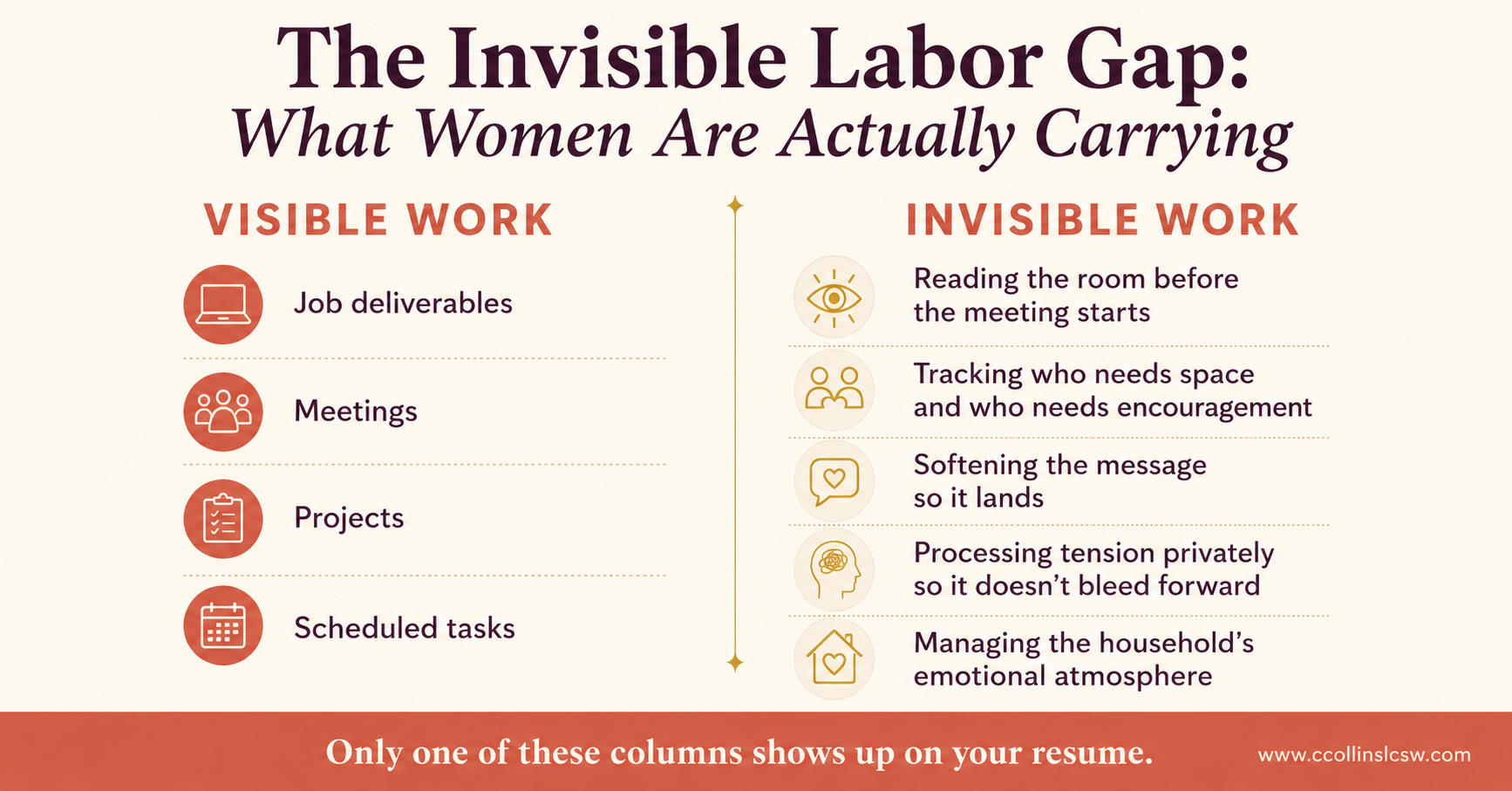
The concept has expanded considerably since then. Today it encompasses the full range of invisible relational work: anticipating needs before they're voiced. Women are tracking the emotional states of everyone around and adjusting behavior accordingly. Reading the gap between what someone says and what they mean, and responding to the real message. Maintaining the relational glue in families, teams, and communities is the continuity of care that keeps everyone feeling seen and connected without anyone formally nominating you for the job.
Research consistently shows this labor is distributed unequally. According to a 2023 Pew Research Center report, women are significantly more likely than men to say they handle the majority of emotional caregiving responsibilities in their households and families even when both partners work full-time. That disparity doesn't come from biology. It comes from socialization: from the messages girls absorb, early and consistently, about what it means to be good, caring, easy to be around. Those messages layer directly onto nervous system wiring especially for women who also grew up in environments where monitoring emotional atmospheres wasn't a social nicety but a genuine survival skill.
The result is a woman for whom emotional labor isn't an occasional professional competency. It is a continuous, automatic, 24-hour-a-day background program running across every context of her life simultaneously. And she is absolutely exhausted in a way she cannot fully explain.
Practical takeaway: For one full day, try to name every moment you adjust your tone, behavior, or words based on monitoring someone else's emotional state. Don't judge it — just count it. The number will tell you something important.
The Fawn Response: When Emotional Labor Isn't a Choice
Here is where I want you to sit with something uncomfortable.
For many high-Q women, emotional labor is not primarily a social pattern or a learned professional behavior. It is a nervous system survival strategy — and survival strategies don't stop running because you decide they should.
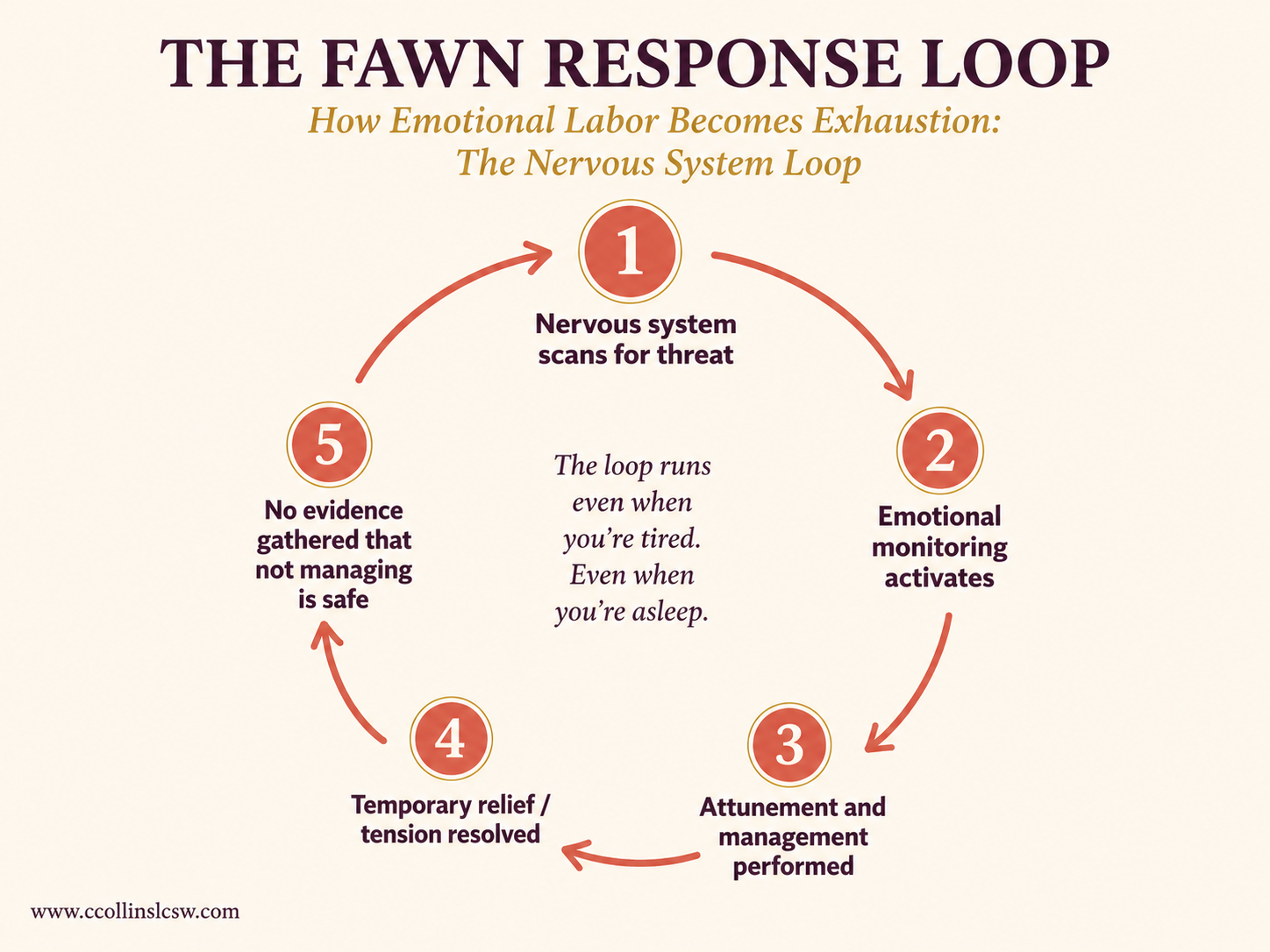
The fawn response — first named by complex PTSD specialist Pete Walker — describes the adaptive strategy of appeasing, accommodating, and managing perceived threats through attentiveness and compliance. In environments where someone else's displeasure was genuinely dangerous, where emotional volatility was unpredictable, where maintaining another person's comfort was the condition of your own safety your nervous system learned to track others' emotional states with precision and to respond to shifts before they could escalate. And this is exactly why women end up codependent behavior patterns. It's learned early and practiced often. It works until it really doesn't.
That is emotional labor in its most foundational form. And it is why, for women whose nervous systems learned this way, the emotional monitoring never really stops. It is not primarily a professional skill or a conscious relational choice. It is the threat-management system running its program. The monitoring isn't optional from the inside. It is automatic.
This means the common advice like communicate more, set expectations, redistribute the labor may address the symptom while leaving the mechanism completely untouched.
For the full picture of how the fawn response drives not just emotional labor but the broader pattern of boundary collapse and people-pleasing, Why the Fawn Response Makes You Cave on Your Boundaries goes much deeper into what's actually happening in the body.
Practical takeaway: Ask yourself: is my attunement to others something I choose, or does it feel compulsive — like something my nervous system does before I decide anything? That distinction matters enormously for what kind of support will actually help.
The Mental Load: Emotional Labor's First Cousin
Emotional labor has a close structural relative that compounds its cost, and they almost always travel together.
The mental load is the invisible cognitive work of tracking, planning, anticipating, and coordinating the details of household, family, and professional life that nobody explicitly assigned to you but that you are clearly doing. You know when everyone's appointments are. You know the household inventory. You know which colleague needs a check-in and which relationship has been neglected. You know what's coming up, what needs to be arranged, what fell through the cracks last week and might again.
This load is continuous. It doesn't clock out.
Research has consistently found this cognitive tracking falls disproportionately on women. A 2021 study published in PLOS ONE found that women's cognitive activity around household management operates even during rest and sleep in ways that men's typically does not. This offers a partial neurological explanation for why women's sleep so often fails to fully restore, and why the exhaustion high-Q women carry has that pervasive, bone-deep quality that a solid night's sleep does not touch.
The mental load and emotional labor are not separate problems. They compound each other. You cannot track everyone's emotional states without also tracking their contexts, their histories, their needs, their histories of conflict. The monitoring is integrated. And it runs continuously.
Practical takeaway: Distinguish between what you're tracking because you chose to and what you're tracking because your nervous system acquired the responsibility and can't seem to release it. The second category is where the invisible load actually lives and it requires a different kind of response than simply deciding to delegate more.
Why "Just Ask for Help" Is Not Enough
Here is what I need to say clearly: the advice most commonly offered to women drowning in invisible labor is not bad advice. Ask for help. Delegate. Communicate what you need. These are reasonable suggestions.
They just don't reach the actual problem.
For women whose emotional labor is driven by nervous system survival wiring — fawn response, hypervigilance, the deep learning that maintaining others' comfort is a prerequisite for connection or safety. The issue is not a communication skills deficit. The issue is that not managing feels like a threat. It feels unsafe.
When not tracking your partner's mood, it feels like abandonment. When not anticipating your colleague's needs feels like professional failure. When not smoothing the family friction before it surfaces feels like the one thing that will break everything. A conversation about redistributing the workload is not going to touch that. It's not the workload, it's what the nervous system believes will happen if you stop.
The solution is nervous system work: building the capacity in your nervous system to tolerate the discomfort of not managing all the things. It's the ability to regulate your nervous system while letting things develop without your preemptive intervention. It's the shift to receive care instead of extending it constantly outward. It's discovering through actual, embodied experience that most relationships are more robust and safer than your threat model suggests.
That shift is the kind of capacity that gets built gradually, through supported work at the level where the pattern actually lives. The post about the causes of burnout addresses the over-responsibility piece of this more directly. it is the level the coaching work I do with high-Q women is aimed at.
Practical takeaway: The next time someone tells you to just ask for help, notice your internal response. If the idea of not managing something triggers anxiety or guilt before you've even stopped doing it, you have located the actual problem.
What Actually Stops the Invisible Clock
Emotional labor will not stop because you decide it should. The monitoring, the anticipating, the continuous attunement are nervous system processes. And nervous system processes don't respond to decisions. They respond to experience.
Specifically: the repeated, embodied experience of not managing and discovering that the outcome was survivable and the relationship didn't collapse. You learn the meeting went fine without your preemptive temperature-reading. You experience your partner handling their own mood without your management of it. You learn you can be fully present in a room without being responsible for its emotional state.
Building that experience requires graduated, intentional practice. Stepping back from one form of invisible labor at a time. You begin tolerating the anxiety that follows and letting the nervous system gather real-time evidence that the world does not require this level of management from you. Learning to activate your polyvagus nerve will help the physiological sensations. This is slow work. And it is the only thing I have seen actually move the needle.
It also requires examining the beliefs underneath the labor. What do you actually believe will happen if you are not attuned to everyone around you? What did you learn, early, about what makes you valuable, lovable, or safe? How much of your emotional labor is in service of your actual values? How much is in service of a story about yourself that you absorbed before you had the language to question it?
Those questions are not rhetorical. They are the work. They are what you do with high-Q women through coaching intensives — not at the level of time management or communication strategies, but at the level where the invisible labor actually originates.
Practical takeaway: Choose one form of emotional labor you performed today. What did I believe would happen if I hadn't done that? The belief underneath the behavior is where the actual change lives.
The Bottom Line
Emotional labor is real work. Expensive work. And it is work that most high-Q women are performing continuously, across every domain of their lives, without acknowledgment, without rest, and without an accurate accounting of what it is costing them.
The exhaustion you feel is not disproportionate. It is the accurate measure of what you are actually doing, most of which is invisible, and none of which appears in the standard burnout conversation.
Naming it is the beginning. Not as accusation, not as complaint, but as an honest reckoning with what you are carrying and what it would actually take to put some of it down.
If you are ready to do that work at the level where it lives, explore Coaching for High-Capacity Women or Apply for Boundaries Breakthrough.
Heal one woman with burnout, teach her how to regulate her nervous system and the impact she experiences changes companies, communities, and culture. Support women leading collaboratively, and the world shifts.
The work nobody sees is the work that's draining you most.
Emotional labor is real, expensive, and running in the background of your nervous system around the clock. Trauma-informed coaching helps high-Q women name the invisible load, understand what's driving it, and build the actual capacity to put some of it down.
Frequently Asked Questions
What is emotional labor and why does it affect women more than men?
Emotional labor — first named by sociologist Arlie Hochschild in The Managed Heart — is the work of managing emotional atmospheres, anticipating others' needs, smoothing friction, and maintaining relational functioning across professional and personal contexts. Research consistently shows women perform a disproportionate share of this labor. This is not biological. It is the product of socialization: girls are broadly trained from early childhood to prioritize others' emotional comfort, to be attuned, to be easy to be around. Those patterns layer directly onto nervous system wiring, particularly for women whose early environments required emotional monitoring, not as a social skill but, as a genuine survival strategy.
How is the mental load different from emotional labor?
Emotional labor is the work of managing emotional states both your own and others'. The mental load is the cognitive work of tracking, planning, and coordinating the details of household, professional, and family life. They're closely related and almost always compound each other: you can't track everyone's emotional states without also tracking their contexts, schedules, and needs. Both are invisible, both fall disproportionately on women, and both consume real physiological resources. Research has found that women's cognitive tracking of household management operates even during rest in ways that differ from men's, which, partially explains why women's sleep restores less completely even when total hours are equal.
Why does emotional labor cause burnout even when my visible workload isn't that heavy?
Because invisible labor is still labor. The monitoring, anticipating, managing, and smoothing that constitutes emotional labor is cognitively and physiologically expensive. It activates the nervous system's threat-detection apparatus and requires continuous output regardless of whether the explicit task list is long or short. According to the American Psychological Association, women consistently report higher average stress levels than men and it's not a backdrop. That is the baseline inside which every emotional labor demand is landing. Sustained low-grade nervous system activation accumulates a fatigue debt that standard recovery modes like sleep, vacation, a quiet weekend doesn't fully address.
Is emotional labor always problematic, or is some of it okay?
Some attunement to others is both normal and valuable. The problem is not emotional labor per se, it's the way it's processed. It's emotional labor that runs as a compulsive nervous system program rather than a chosen, boundaried expression of care. When the monitoring is automatic, continuous, and connected to a deep belief that not performing it carries relational or safety consequences, it's operating as a survival strategy, not a choice. That's the version worth examining because compulsive attunement is expensive, unsustainable, and driven by something other than what you actually value.
What does it look like to reduce emotional labor without damaging my relationships?
Reducing emotional labor is not the same as becoming less caring. It is the process of making your attunement a choice rather than a compulsion. It's the choice of stepping back from the preemptive management that happens before you decide to do it, and discovering that most relationships are more robust and safer than your nervous system's makes you feel. It's done gradually, starting in lower-stakes contexts, and it requires tolerating the discomfort of not managing until the nervous system updates its estimate of what actually happens when you don't. Coaching can support that process in a structured, supported way.
What is the difference between therapy and coaching for emotional labor patterns?
Therapy is a licensed clinical service addressing mental health diagnosis, trauma processing, and psychological treatment. Coaching is educational and developmental It is not therapy and is not a substitute for mental health care. Courtenay Collins, LCSW, brings 25+ years of clinical trauma expertise to trauma-informed coaching intensives for high-Q women. Her clinical background informs the precision and depth of the work, but these are coaching programs, not clinical treatment. Women who need mental health care should seek a licensed provider in their state.