
Somewhere along the way, you learned that you were a lot.
Maybe it was said directly. Maybe it lived in a sigh, in the way someone's body shifted when you said the thing you were actually thinking, or in the pause before a response that told you, without a word, to dial it back. However it arrived, the message landed: stay smaller. Stay easier. Keep the ocean inside you and let people see a puddle. Because a puddle, you learned, was already more than enough.
And you adapted. Because that's what smart, high-capacity women do. You calibrated. You edited before speaking. You became excellent at the pause between feeling something and performing something more acceptable instead.
But here is what I've watched happen across 25 years of sitting with women: the ocean doesn't disappear. It goes underground. And the pressure of that going nowhere is what you're feeling now. It shows as boredom, resentment, a numbness you can't explain, or the particular ache of a life that looks completely fine and doesn't feel fully inhabited.
You are not too much. You are under-expressed. And those are completely different problems with completely different solutions.
Think of a house with every window painted shut. Nothing is technically broken. But no air gets in. That is what long-term self-suppression does to a woman. You are still standing, still functioning, still carrying everything and you cannot seem to get a complete breath.
This post is about what happens to your body, your identity, and your desire when self-expression gets suppressed long enough to become a habit. And what it actually takes to reclaim yourself. It's dramatic. No need to blow up your life. It's a way of returning to yourself, of coming back to you.
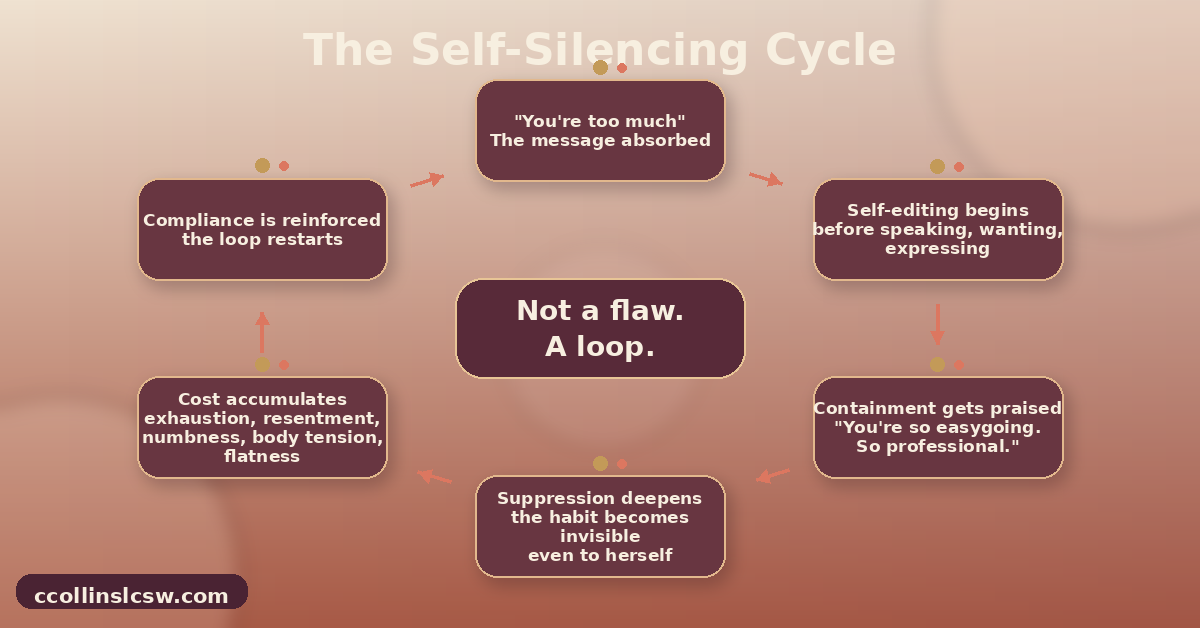
Shows the reinforcing loop that keeps under-expression in place — so readers can see the pattern as a system, not a character flaw.
"Too Much" Is What Powerful Women Are Called Before They're Fully Understood
There is a long, dull history of reducing women by volume. Too loud. Too emotional. Too ambitious. Too sexual. Too angry. Too intense. Too needy. Too sensitive. Too much.
The language shifts depending on the decade and the room. But the function stays the same: to locate the problem inside the woman rather than inside a culture that can't hold her.
Dana Crowley Jack, EdD — Professor at Western Washington University and one of the foremost researchers on women's depression spent decades studying what she named the self-silencing schema: the internalized set of rules that lead women to suppress their authentic thoughts, feelings, and needs in order to maintain relationships and avoid negative judgment. Her research found something crucial: self-silencing is not a personality trait. It is a learned survival strategy. And it carries measurable costs to psychological health, including depression, loss of identity, and disconnection from the self's own needs and desires.
The language of "too much" is the front door to self-silencing. Once a woman accepts that her natural level of feeling, wanting, or speaking is excessive, she becomes the primary editor of her own interior life. She is constantly self-checking against a standard she didn't set and was never allowed to revise.
According to the APA's 2024 Stress in America survey, women are more likely than men to feel that major events will have a significant impact on their daily lives and futures. This disparity that reflects not just higher stress loads, but a deeper attunement to consequence. Women who have learned that their expression carries real social and relational risk become hypervigilant to exactly that risk. Every room becomes a calculation. And the labor of that weighs heavier over time.
Practical takeaway: Notice the next time you begin a sentence with "I don't want to be too ____." That phrase is where the editing begins. Start witnessing that it's happening.
Containment Gets Praised Until It Becomes a Cage
Here is a thing that is both true and uncomfortable: the woman who has suppressed herself most successfully is often the one most rewarded for it.
She's described as easygoing, professional, mature. She doesn't make scenes. She handles things. She doesn't need much. She's a pleasure to work with. Every one of those compliments can be genuine. And every one of them can become the bar she quietly breaks herself against.
I've worked with women for nearly 3 decades in every stage of life/growth and development and the through-line is consistent. The woman who learned earliest to make herself small is often the most reliably productive.
Her containment gets her ahead professionally. It earns her the descriptors: level-headed, dependable, low-maintenance. It gets her trusted with more. And it costs her something she may not have named yet, because the cost doesn't present as suffering. It presents as exhaustion that sleep doesn't fix and resentment that feels disproportionate to what's actually happening.
McKinsey's 2024 Women in the Workplace report found that 43% of women in senior leadership roles report burnout compared to 31% of their male counterparts. The gap is the accumulated arithmetic of absorbing more than your share of the invisible load and receiving praise for doing it without complaint.
Lareina Yee, Senior Partner at McKinsey & Company, named it plainly in describing the research: women in leadership are, in her words, "hanging on." High performance and profound depletion have become inseparable for many of them. And the connection between the two often traces back to something that starts long before the leadership title: they learned that staying useful, pleasant, and contained was how you earned your place. That lesson didn't leave when they got promoted.
The cage doesn't feel like a cage at first. It feels like professionalism. It is not rocking the boat. It's being known for being the stable one. These labels aren't problematic until holding it together is the only mode you have access to, until you're so diminished you lose yourself.
Practical takeaway: Ask yourself: when was the last time you said something that surprised someone not a performance of personality, but something you actually felt? If you can't remember, that's information.
The Signs Are Boredom, Resentment, and a Hunger You Can't Name
Under-expression doesn't always announce itself as suppression. It's subtler than that. It creeps in as flatness. It's the sense that you've been going through the motions longer than you can track. As resentment it arrives bigger than its trigger. It feels like a persistent, low-grade dissatisfaction that no accomplishment quite fills.
I've watched it show up clinically like this: the woman who weeps during a song she can't explain, because that feeling finally escaped through the only crack available.
She is the woman who fantasizes about quitting everything and everyone and going somewhere no one knows her name because her life doesn't quite feel like hers. And she feels more like a useful tool than a human being.
It's the woman who describes herself as "fine" with a flatness that tells you she's stopped expecting anything else.
Brené Brown, PhD, LCSW — research professor at the University of Houston and author of Daring Greatly — has written about one of the most important dynamics in suppression: you cannot selectively numb. You can't compartmentalize it forever. It will leak into everything.
When you shut down the emotions that feel too risky to express — the anger, the longing, the grief, the want — you don't get to keep the ones you preferred. The mechanism covers everything. You don't get to suppress the wildness and hold onto the joy. It doesn't work that way.
According to a YouGov survey, 56% of women identify as people-pleasers compared to 42% of men. Among women who self-identify this way, nearly half say the pattern has made their life significantly harder. Under the people-pleasing is almost always a more original strategy: if I stay palatable, I stay safe. The hunger underneath it is not ingratitude. It is not immaturity. It is a true, real version of self asking, repeatedly, to be let back in.
Practical takeaway: Write down three things you stopped doing. What have you stopped saying, stopped wanting, stopped pursuing because someone (directly or indirectly) made you feel you were too much? That list is part of your map back.
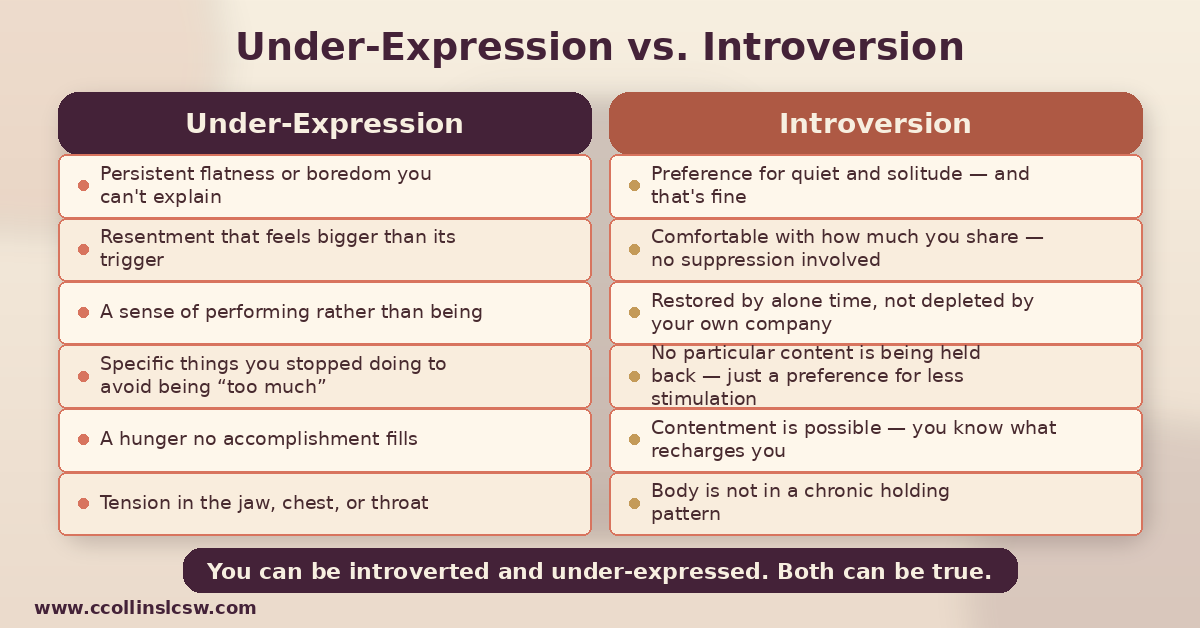
Distinguish between under-expression (a suppression pattern with a path out) and introversion (a temperament that is not a problem). Many high-capacity women conflate the two.
Your Body Is Carrying All the Words You Never Let Yourself Say
This is the part that doesn't make it into the conversation nearly enough: suppression doesn't stay abstract. It goes somewhere specific. And that somewhere is the body.
Women who have spent years editing, calibrating, and containing themselves often describe physical symptoms with no clean medical origin — chronic tension in the jaw and throat, a chest that feels perpetually tight, exhaustion that sleep doesn't touch, a heaviness that isn't quite grief and isn't quite anxiety but lives somewhere between the two. Restlessness that's difficult to name. Headaches that arrive in the aftermath of conversations where she most wanted to say something and didn't.
This is psychosomatic in the purest definition. This is somatic truth which is consistently dismissed as, “it's all in your head."
Bessel van der Kolk, MD — trauma specialist, psychiatrist, and author of The Body Keeps the Score — has documented extensively how unexpressed emotion, particularly when chronic, keeps the autonomic nervous system in a state of managed tension. Not full crisis. Not obvious distress. Just holding. And holding, over years and decades, takes a measurable physical, as well as, psychological toll.
A 2024 meta-analysis published in Health Psychology Review from researchers at Baylor University examined data from across multiple studies and found that emotional suppression is consistently associated with elevated stress-related physiological responses. That includes higher cardiovascular reactivity and impaired recovery from stress. The body is not neutral to what the voice is not allowed to carry. The suppression you absorb relationally, your nervous system absorbs physically.
In my professional experience, I've seen this show up in women as Chronic Fatigue Syndrome and fibromyalgia symptoms and even, immuno-issues. It takes a measurable toll.
This is why reclaiming expression is not self-indulgent. It is not a luxury reserved for women with fewer responsibilities. It is physiological repair.
Practical takeaway: Put one hand on your chest and one at your throat — whichever holds tension first. Take three slow exhales, longer on the out-breath than the in. Notice what shifts, even slightly. That's your nervous system offering you a door.
If what you're reading is landing in the context of a larger shift you're navigating — a season that doesn't have a name yet — this post on what midlife identity actually asks of high-capacity women speaks directly to what's underneath it.
Desire Is Not Frivolous. It Is Directional.
One of the specific casualties of long-term under-expression is desire. Not just sexual desire, though that's part of it, but, the whole spectrum: creative hunger, spiritual aliveness, the impulse to make something or go somewhere or become someone you don't have language for yet.
Women are taught, early and persistently, that their desires are suspect. Too self-indulgent. Too risky. Too costly. Too much for anyone else to accommodate. The result is a woman who has learned to want in secret or not to want at all. Who defaults to practicality because she stopped trusting her own longing long ago, and calling herself a realist became easier.
Clarissa Pinkola Estés, PhD, Jungian analyst and author of Women Who Run With the Wolves, describes the instinctual nature in women as a life force that, when denied expression, does not disappear quietly. It turns. It manifests as depression, compulsion, restlessness, or the particular grief of a life that is technically fine and doesn't feel fully inhabited. The wild nature, as she calls it, is not temperamental. It is directional. When it goes unlistened to for long enough, it finds other outlets.
Research supports this a 2022 study from Mississippi State University, drawing on data from nearly 300 women aged 40 to 84, found that women who identified with a creative pursuit as part of their core identity, rather than treating it as a peripheral afterthought, showed significantly better mental well-being and more positive attitudes about aging. The creative act is not decoration. For women who have been containing themselves, it is often the first route back to themselves.
Desire is information.
Creative desire tells you where your energy wants to flow.
Relational desire tells you where your need for depth is going unmet.
Sensual desire tells you that you are still alive in your body.
Spiritual desire tells you that you are still reaching for something larger than survival.
None of these are problems to be managed. They are maps.
Practical takeaway: Name one desire — just one — that you've called impractical, self-indulgent, or too much in the last year. Ask yourself what would it cost to take it seriously? What has it cost you not to?
Wild Does Not Mean Reckless. Wise Does Not Mean Tame.
This is the polarity that matters most and it's one most women were never offered.
The cultural deal handed to women is this: be useful and contained, or be expressive and chaotic. Be the good one or be the difficult one. Be palatable or be too much. As though the only alternative to tight self-management is combustion.
It's not.
Wild, in the truest sense, means alive to your instincts. Attuned to what you actually feel, what you actually want, what your body is telling you before the editing begins. It means being present to your own interior life without immediately checking it against what's acceptable. Wild is not the absence of discernment. It is the presence of contact — with yourself.
Wise means you can hold that aliveness with discernment. You don't say every true thing in every room. You choose where and with whom you bring your full self. Wisdom is not the suppression of wildness. It is the navigation.
Glennon Doyle, author of Untamed and founder of Together Rising, describes the cultural conditioning of women as learning to be "good girls" rather than fully alive ones: to prioritize the comfort of others, to stay tame, to call the cage a palace. The women she's spoken to around the world describe the same loss: not of something specific, but of a quality of aliveness that got gradually edited out of them.
Gallup's ongoing workplace research found that women in leadership roles experience burnout at an average of 29% compared to 19% for men in equivalent roles. That's a 10-point gap that remained consistent from 2022 through 2025. That gap is not closing. And it is not primarily a workload problem. It is partly the cost of performing a curated version of yourself rather than being yourself, while simultaneously being expected to carry more than anyone else in the room.
Practical takeaway: Write down one thing you have wanted to say, do, or become not because you changed your mind, but because it felt like too much for someone else to hold. Don't justify it. Don't plan for it. Just let it exist on the page for a moment.
This is the work at the center of the Wild and Wise intensive recovering what got buried, and learning to bring it forward without burning down everything that matters. Not becoming unrecognizable. Becoming more fully yourself.
Reclamation Needs Witnesses Not Just Realizations
Insight is necessary. It is not sufficient.
You can understand, clearly and fully, that you have been suppressing yourself for decades and still not be able to stop. Not because you are weak. Because the suppression is encoded in the nervous system, below the level of conscious intention. And the nervous system is not changed by logic. It is changed by experience: new, repeated, embodied experience of something different.
That is why the container matters. That is why journaling about this, or understanding it at 2am, or having the insight and then white-knuckling through the next morning none of that creates the shift the shift requires.
James Pennebaker, PhD, Professor of Psychology at the University of Texas at Austin is one of the foremost researchers on expressive writing and health. He has spent over four decades studying what happens when people give full expression to what they've been carrying. In his landmark research, students who wrote honestly about their emotional experiences for just four days had roughly half the number of student health center visits over the following six months compared to those who didn't. Telling the true story in a container that can receive it is not just cathartic. It is physiologically regulatory.
Small-group work at its best offers something specific: maybe advice, maybe solutions,but the experience of bringing yourself fully into a room and being met there. In well led small-group wok you are seen without being edited, heard without being redirected. Small group experience, repeated, does something in the nervous system that thinking about it alone cannot replicate.
Courtenay Collins, LCSW, brings 25+ years of clinical trauma expertise to the Wild and Wise intensive. The core of that work is not content delivery. It is the experience of being witnessed without correction.
Practical takeaway: Ask yourself this: "Where am I calling myself too much when the truth is I'm finally telling the truth?" Let that question sit for longer than feels comfortable. The answer is usually already there.
The Bottom Line
You are not too much.
You are told you are being too much by people who couldn't hold you. It led to deciding, somewhere along the way, that the problem was you. The editing you've been doing, you know the constant, relentless calibrating, the shrinking, the pre-emptive softening has kept a lot of unhealthy relationship dynamics in your life. It has made you easy to be around. It has also been exhausting you at a level that no vacation, no optimization routine, and no wellness strategy can touch, because none of those things reach the root.
The root is a woman who stopped letting herself be fully real, because the cost felt too high. And, sometimes, the cost was too high because it became dangerous to choose yourself.
Real reclamation is not dramatic. It is not throwing everything overboard. It is slowly, carefully, with the right support, learning to bring more of yourself into the rooms you already inhabit. You start to say the truer thing. You start to want the harder thing. You finally trust that the people worth keeping can handle who you actually are.
“When we help women heal, repair, recover, and sustain — without burnout or over-functioning — she transforms companies, communities, and culture.”
That shift we are culturally desperate for doesn't start with a program or a framework or a better coping strategy. It starts with one woman stopping the editing.
If you are tired of being palatable at the expense of being alive, explore Wild and Wise or Coaching for High-Capacity Women.
The woman you've been containing? She is not too much. She is overdue.
Tired of being palatable at the expense of being alive?
Wild and Wise is a small-group intensive for women who are done editing themselves into something smaller. This is not a place where you will be fixed. It is a place where you will be witnessed — and that is exactly where reclamation begins.
Frequently Asked Questions
What does "women feeling too much" mean and is the experience real?
The experience of being told you feel too much, want too much, or express too much is one of the most common things high-capacity women describe. It carries real consequences. In most cases it reflects a mismatch between a woman's natural depth and the capacity of the people around her to hold it. The problem is rarely the woman's amplitude. It is the room's tolerance. Over time, being told, explicitly or implicitly, that you are too much becomes a belief you organize your behavior around. Dana Crowley Jack's decades of research on self-silencing confirm that this is not a quirk or a sensitivity issue. It is a learned strategy with measurable psychological costs, including depression and loss of a coherent sense of self.
What are the signs I'm under-expressed rather than just introverted or private?
Under-expression is different from introversion, and the distinction matters. Introversion is a preference for less stimulation. It's a temperament, not a suppression pattern. Under-expression shows up as persistent flatness or boredom you can't explain, resentment that feels disproportionate to its trigger, a sense of performing a version of yourself rather than being yourself, and a hunger that accomplishments don't fill. A key marker: you can name specific things you stopped saying, doing, or wanting because someone made you feel they were too much. That list has specific, traceable contraction. Any behavior which led to contraction, diminishment of a feeling of compression you authenticity is under-expression.
Can emotional suppression actually cause physical symptoms?
Yes. From a trauma-informed and somatic perspective, chronic suppression keeps the nervous system in a state of managed tension. A 2024 meta-analysis published in Health Psychology Review, conducted by researchers at Baylor University, found that emotional suppression is associated with elevated stress-related physiological responses, including higher cardiovascular reactivity and impaired recovery from stress. The body absorbs what the voice is not allowed to carry. Jaw tension, chronic throat tightness, unexplained fatigue, and a heaviness that lives between grief and anxiety are common physical signatures of long-term under-expression.
Is Wild and Wise therapy? What is the difference between therapy and coaching?
Wild and Wise and Courtenay Collins's other intensives are trauma-informed coaching — educational and developmental in nature, not therapy and not a substitute for clinical mental health care. Therapy is a licensed service that addresses diagnosis, trauma processing, and mental health treatment. Courtenay Collins, LCSW, brings 25+ years of clinical trauma expertise to this work, which informs its depth and nervous-system literacy. The intensives are clinically informed educational training with support during implementation of specific skills. If you are unsure whether coaching or therapy is the right fit for where you currently are, that conversation is built into the application process.
What if I don't know what I want to reclaim? Can I still show up for Wild and Wise?
Yes. Most women arrive in exactly that place. You may need clarity about what you want; you may just need a space in which to find it. Wild and Wise is designed for women who know something is missing but may not yet have language for what. Part of the work of the intensive is the process of naming what got buried and finding out whether you want it back. You can arrive with a plan. More importantly you come willingly.
Why do high-capacity, high-achieving women specifically struggle with self-expression?
Because high-capacity women are often the ones most rewarded for suppression. They get praised for being professional, easygoing, reliable, and not needing much — which trains the nervous system to associate containment with approval and belonging. They carry disproportionate emotional labor. They are held to a higher standard of self-regulation than their male peers. And their competence makes their suppression invisible even to themselves. The most capable women I work with are often the ones who have been editing themselves the longest, because they were so good at it that no one ever told them to stop.
I've read the books and done the journaling. Why hasn't the pattern changed?
Because insight changes understanding, not nervous-system patterns. You can know clearly and fully that you've been suppressing yourself for decades, and still find the same behavior running the moment the pressure is real. That is not a failure of resolve. The suppression is encoded below the level of conscious thought. What creates lasting change is new, embodied, relational experience: being witnessed differently, in a supported container, repeatedly while the system recalibrates. That is different from what individual reading, journaling, or most self-directed work provides. It is the specific kind of change that witnessed group experience is built to create.
Courtenay Collins is a psychotherapist turned trauma-informed coach. This program is educational and coaching-based, not therapy or a substitute for psychotherapy, diagnosis, or mental health treatment.