

Something has been building.
Maybe you can't name it exactly. But you know the feeling. You look at your calendar and want to cancel everything. You're short with people you love. You've started noticing how many times a day you say things you don't mean. You're tired in a way that sleep doesn't touch. You want to cut your hair, or your commitments, or both. You're done being so goddamn agreeable. And, oh boy, does that adult beverage help you manage those after school/ after work hours. I call it prickly (like a cactus). If you leave a cactus alone - it’s all good. Get too close and things degrade.
And you have no clean story for why.
The life you built is, by most measures, a good one. You are capable and accomplished and widely regarded as someone who has it together. Which makes the itch you cannot scratch — the low-grade restlessness, the quiet fury, the feeling that the version of yourself you've been performing no longer fits — even harder to explain.
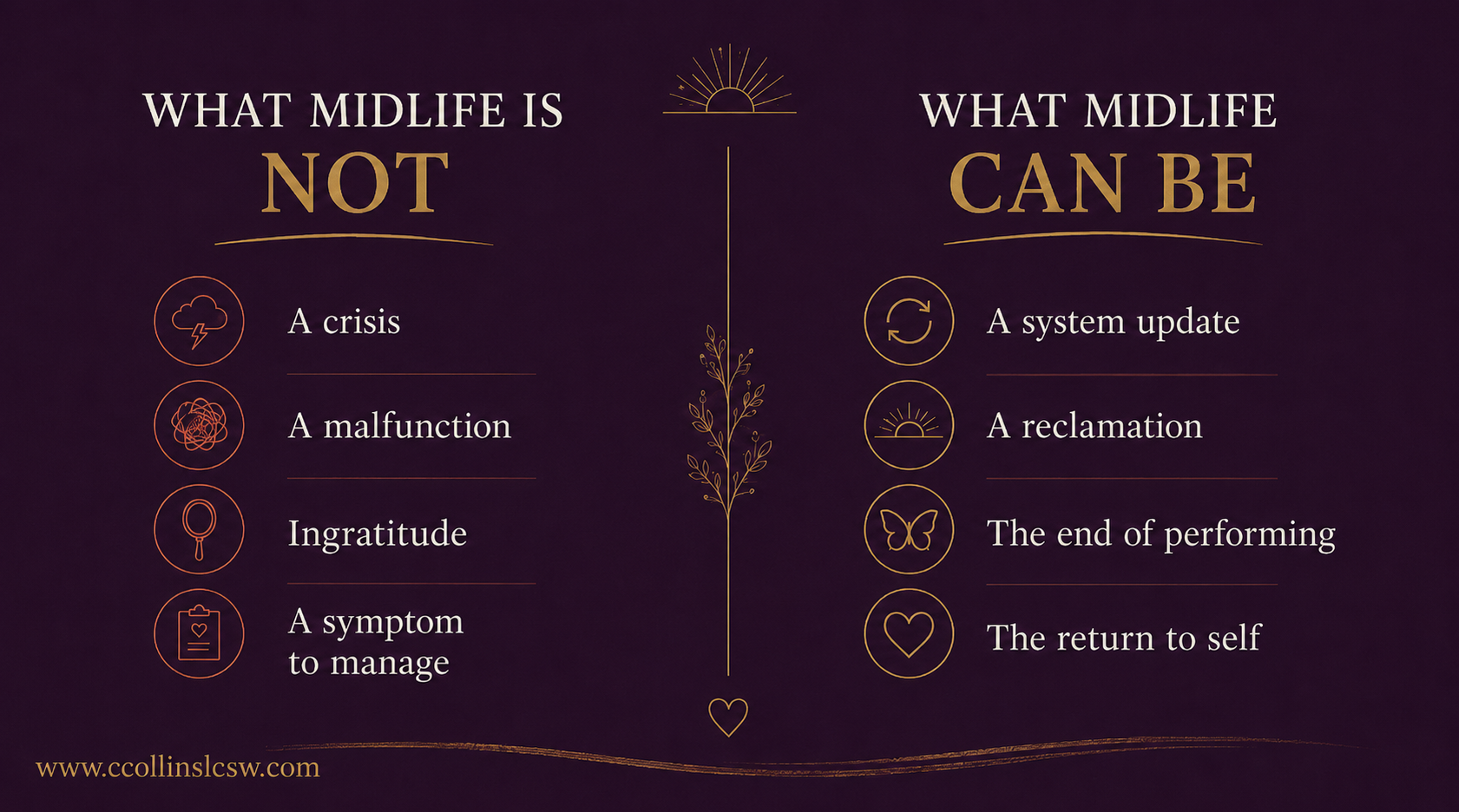
Here is what I want to offer you: this is not a breakdown. This is not ingratitude. This is not hormones turning you irrational, and it is not a midlife crisis in the dramatic, red-sports-car sense. What is happening is more interesting than that, and more useful.
Your operating system is running an update. And like every major update, it is temporarily disrupting everything because the old version can no longer run the life you actually want.
After 25+ years of working with high-capacity women, here is what I know: midlife is not the place where women fall apart. It is the place where they stop pretending.
What If This Is Not a Breakdown?
The language we have for this moment is almost entirely pathological. Crisis. Breakdown. Instability. Even the phrase "midlife crisis" frames the experience as a malfunction — something to be corrected or survived, ideally as quickly and quietly as possible.
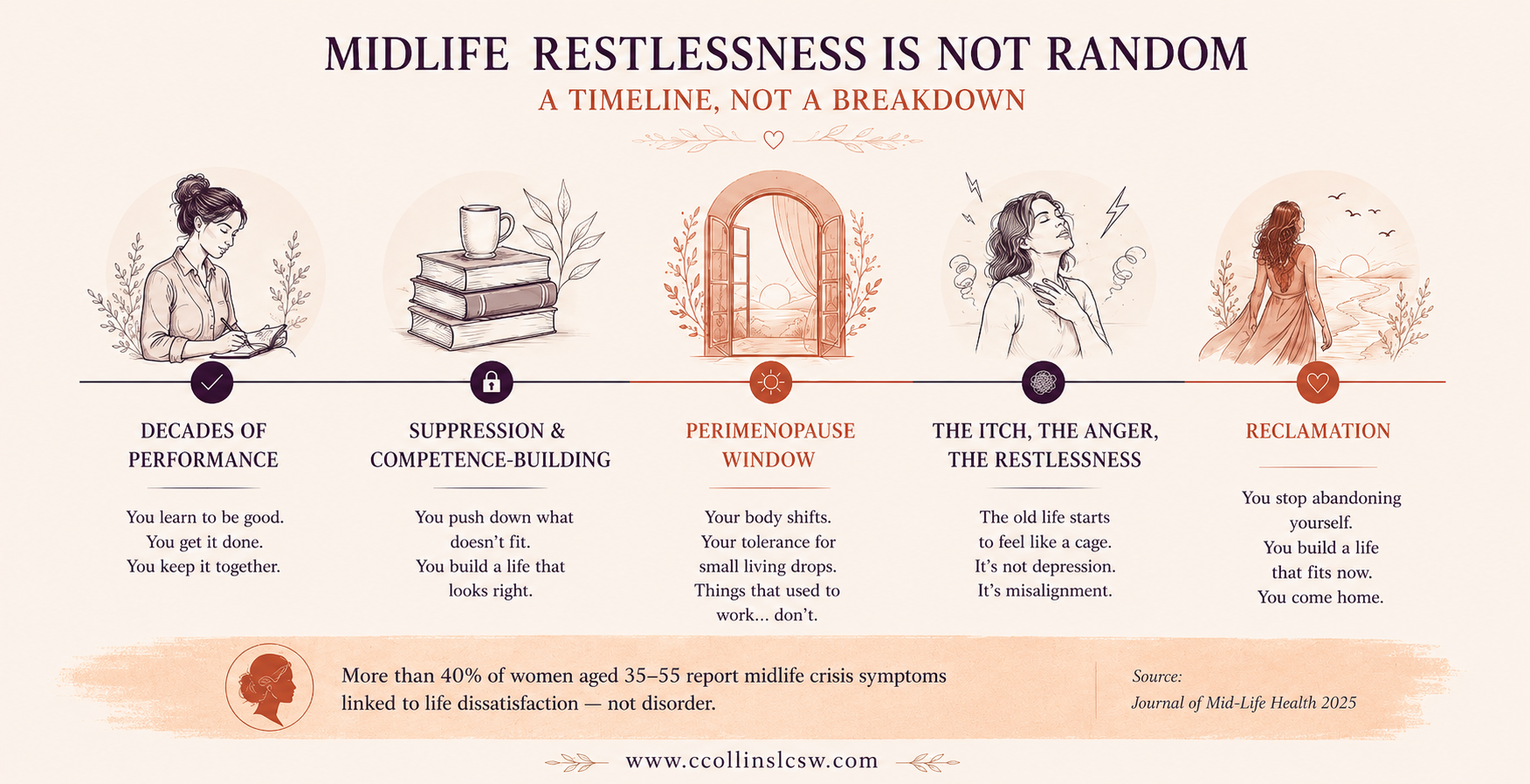
But research suggests a more complicated picture. A 2025 study published in the Journal of Mid-Life Health found that more than 40% of women aged 35–55 reported midlife crisis symptoms — and that those symptoms clustered not around genuine disorder, but around life dissatisfaction: the gap between the life being lived and the life that felt true.
That distinction matters. A woman who feels dissatisfied with a life she built to other people's specifications is not malfunctioning. She is accurate.
Dr. Mary Pipher, psychologist and author of Reviving Ophelia and Women Rowing North, writes about midlife as a time of profound potential reorientation — a stage in which women are finally positioned to live by their own values rather than inherited ones. Brené Brown has written about midlife as "a spiritual awakening" — the moment when the armor built over decades gets too heavy to keep carrying.
I have watched this happen too many times to mistake it for malfunction. Women take off the armor and have no idea who or what kind of woman they want to be. The women who walk into my work in midlife are not breaking. They are clarifying. The distress is real — but the distress is information, not diagnosis.
Practical takeaway: When the discomfort of midlife feels like something is going wrong, try reframing the question. What if nothing is going wrong? What if something is finally going right, and the old system is resisting it?
The Life That Looked Good May Not Feel True Anymore
This is the part nobody warns you about.
You can do everything correctly — build the career, hold the marriage together, raise the children, show up for the parents, keep the household running, be the person everyone counts on — and arrive in your mid-forties with a life that looks like a success story and feels like a costume.
External success and internal alignment are not the same thing. I call the integrity of self. It’s the idea that what you want, who you are, who you want to be are part of how you live. It’s the idea that your true self is the one who is also doing all the things.
For many high-capacity women, the decade or two between "figuring out how to succeed" and "figuring out what you actually want" is spent building infrastructure for someone else's definition of the good life. The woman you became to survive your twenties, to earn your place in your thirties, to hold everything together in your early forties — that woman did what she had to do. She was resourceful and strategic and probably extraordinary.
But she was also built for other people's comfort. And somewhere between forty and whenever, the fit starts to itch.
Glennon Doyle writes in Untamed that many women "live performing" — running a script so long they forget they didn't write it. The midlife moment of rupture is often the first time that script becomes loud enough to hear clearly. Not because something has gone wrong. Because the tolerance for performing it has finally run out.
This is not ingratitude. It is not selfishness. It is the natural endpoint of spending years suppressing the self in service of a role — and the beginning of something that, if you let it, will take you somewhere more honest. I like to ask: “who do you want to be?”
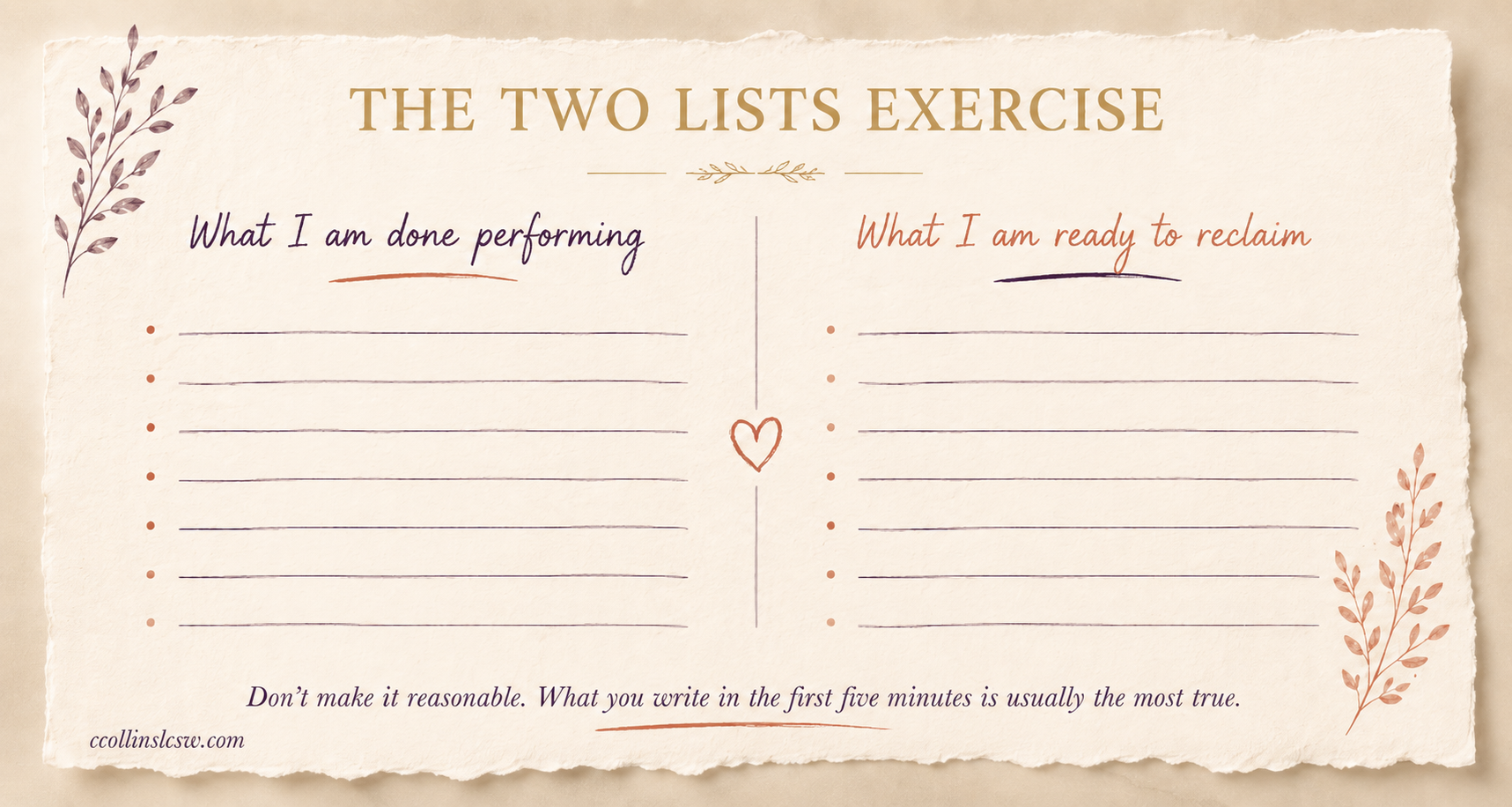
Practical takeaway: Make two lists. What am I done performing? And: what am I ready to reclaim? Don't edit either list. Don't make it reasonable. What you write in the first five minutes is usually the most true.
Hormones May Be Part of the Story — But They Are Not the Whole Damn Plot
Let's be honest about perimenopause, because it is real, it is physiological, and it deserves more than a footnote.
As estrogen begins to fluctuate in the years before menopause, it affects the prefrontal cortex, the hippocampus, and the amygdala — the brain's centers for planning, memory, and emotional regulation. Research published in 2025 confirms that estradiol fluctuations can disrupt dopamine, serotonin, and norepinephrine, contributing to mood instability, irritability, brain fog, and disrupted sleep. A Newson Health survey of nearly 6,000 women found that 95% had experienced a negative change in mood or emotions during this transition. Irritability was the primary mood complaint for up to 70% of women during perimenopause. (oh and let’s not forget about the misinformation about estrogen and breast cancer was misreported for decades so women didn't or couldn’t get hormonal support.)
This is real. Name it. Get support if you need it. Hormone replacement therapy helps some women significantly. A good clinician who takes perimenopausal symptoms seriously — not one who dismisses them — is worth finding.
And.
Hormones do not explain everything.
They do not explain the twenty-year-old marriage that has quietly become a performance. They do not explain the career that looks like achievement and feels like a cage. They do not explain the grief about the decade you spent being agreeable instead of honest. They do not explain why the people who love you keep telling you to calm down when what you actually feel is: finally awake.
The hormonal story is real and important. It is also sometimes used — by well-meaning doctors, partners, and the culture at large — to reduce a woman's legitimate reckoning to a symptom that can be managed away.
Your body is changing. It is also, at the same time, telling you something that has been true for a long time. Both things can be happening at once.
Some of the deepest inner healing I have experienced was in my mid-40’s about my self-worth, my bodily autonomy and sovereignty. It has significantly impacted how I entered decade 5.
Practical takeaway: If you suspect perimenopausal symptoms are affecting you, pursue medical evaluation — that is self-care, not weakness. And simultaneously, refuse to let the medical frame swallow the full truth of what is moving in you.
Anger Can Be an Awakening
Here is something worth sitting with: the irritability and anger that show up in midlife are not random.
For many high-capacity women, decades of suppression precede the rage. Decades of softening the truth, absorbing other people's moods, managing the emotional temperature of every room, making yourself smaller to make other people more comfortable. Decades of over-explaining and over-apologizing and making your needs negotiable while other people's needs were not.
At some point, the suppression breaks. And what comes out does not look gentle.
Dr. Elizabeth Jenkins, a psychotherapist specializing in midlife transitions, has noted that women at this stage have "reached peak pressure in terms of the demands expected of them" — managing teenagers, aging parents, and careers simultaneously, often while still being held to an invisible standard of gracious availability. The anger, she suggests, is not irrational. It is the accumulated cost of that standard becoming visible.
This anger is information. It is telling you what you've tolerated past the point of honesty. It is pointing at the places where you've been agreeable when you should have been clear, available when you should have had limits, accommodating when you had every right to say no.
The task is not to manage the anger back into compliance. The task is to listen to it with the same precision you'd apply to anything else that contains important data.
Anger in midlife is often the first honest thing a high-capacity woman has let herself feel in years. Treat it accordingly.
Practical takeaway: When midlife anger arrives, resist the urge to immediately apologize for it or explain it away. Instead, ask: what has this feeling been protecting? What did I say yes to for too long that this is finally saying no to?
Desire Returns When Performance Starts to Crack
Here is what I watch happen, over and over, when high-capacity women finally let the performance slip: desire comes back.
Not just sexual desire — though that too, for many women who believed that part of them had simply aged out of relevance. Desire in the larger sense.
The appetite for things that are genuinely for them. Creativity that was shelved in favor of productivity. Curiosity that was deferred in favor of competence. The spiritual hunger that got pushed aside because there wasn't room for it in a life built around other people's needs. The adventure that seemed selfish. The beauty that seemed frivolous. The voice that had been calibrated for other people's comfort for so long it had forgotten its own register.
This is the midlife gift that rarely makes it into the cultural narrative: when women stop performing the version of themselves that was built for approval, what they often find underneath is not emptiness. It is more.
More honesty. More appetite. More willingness to disappoint people in order to stay true. More capacity for genuine pleasure because the energy previously spent on performance is now available for something real. More willingness to take up space, make bold choices, say difficult things, want things without apology.
Glennon Doyle describes this as coming home to herself. Carl Jung framed midlife as the necessary movement toward individuation — the process of becoming fully, specifically oneself rather than a composite of social roles and expectations. Whatever frame you use, the clinical pattern is consistent: when the performance cracks, what is underneath is not less. It is the person who was always there, waiting.
Practical takeaway: What did you want before you learned to want the right things? Not the responsible answer. The one you'd write if no one was watching. That list is a map.
The Question Is Not "Who Am I Now?" It Is "Who Did I Stop Being?"
The disorientation of midlife is often framed as a question of identity: Who am I now? As if the self has been lost and must be invented fresh from scratch.
I think that framing is wrong. Or at least incomplete.
A useful question is the one that looks backward: Who did I stop being? What parts of yourself were set aside — for competence, for approval, for other people's comfort, for the version of success you were given rather than the one you might have chosen? What got quiet when the performance got louder?
However, I think a more specific question is” who do you want to be? Most woman can remember who they stopped being but it is not really who fits them now either after kids, divorces, promotions, lessons learned and all the lived experiences. Midlife is the time when are, hopefully, emotionally mature and healthy enough to get to a place and say: This is who I want to be and then we do it!
Reclamation is not the same as reinvention. Reinvention implies the old self was a failure. Reclamation acknowledges that the self was always there, underneath the roles and the rules and the decades of managing other people's reactions to you.
The midlife identity shift is not a crisis of not knowing yourself. It is usually the beginning of knowing yourself more honestly than you ever have before — now that the cost of performing someone else's version of you has become higher than the cost of being seen.
This is the work. Who do you want to become. How do you want to feel. How do you want to belong to yourself again - who do you come home to.
Practical takeaway: Before you reach for a new identity, take inventory of what was set aside. The creative practice. The opinions expressed without apology. The body treated as something to inhabit rather than manage. The relationships maintained on your terms. These are not new directions. They are directions home.
Wild and Wise Is for the Woman Who Is Done Shrinking
I did not name this intensive carelessly.
Wild because the most alive version of most women I know is the one that got disciplined out of her. The one that was too much, too direct, too appetitive, too honest for the rooms she was supposed to fit into. The one that got managed down into something more palatable and has been waiting for permission to come back.
Wise because this is not about becoming someone new. It is about finally trusting the accumulated intelligence of your own experience. The pattern recognition. The bone-deep knowing. The clarity that arrives when you stop performing confusion in order to make other people more comfortable.
The Wild and Wise intensive is for the woman in midlife who is done negotiating with the life she built for everyone else's comfort — and is ready to build something that is actually hers. Not a crisis response. Not a reinvention. A return.
We work with the specific patterns underneath the restlessness: the over-responsibility that has been mistaken for strength, the people-pleasing that has been mistaken for kindness, the emotional labor that has been invisible for so long it became her entire identity. We work with the body — not as a problem to manage, but as the primary source of information about what is true.
If midlife has made you allergic to the old rules, Wild and Wise is the room where that restlessness becomes direction.
Explore Coaching for High-Capacity Women or Apply for Wild and Wise.
Heal one woman without burnout, and she changes companies, communities, and culture. Support women leading collaboratively, and the world shifts.
The restlessness you feel is not a malfunction. It's a message.
Wild and Wise is a trauma-informed coaching intensive for high-capacity women in midlife who are done performing a version of themselves that no longer fits. If you're ready to stop shrinking, stop explaining yourself, and start building a life that is actually yours — explore your next step.
FREQUENTLY ASKED QUESTIONS
Is what I'm feeling in midlife actually a crisis?
Maybe. And maybe it's something more useful. A 2025 study in the Journal of Mid-Life Health found that more than 40% of women aged 35–55 reported midlife crisis symptoms — and that those symptoms tracked closely with life dissatisfaction, not clinical disorder. A woman who feels restless in a life that was built to someone else's specifications is not malfunctioning. She is accurate. The clinical word "crisis" tends to pathologize what is often a very legitimate reckoning. Courtenay Collins, LCSW, works with midlife identity shifts through a trauma-informed coaching lens: not as symptoms to be managed, but as information to be acted on.
How do I know if my mood changes are perimenopause or something deeper?
Often both are true at once. Perimenopause is real, physiological, and underrecognized — estrogen fluctuations affect the brain's centers for mood, memory, and emotional regulation, and up to 70% of women report irritability as a primary symptom. That deserves medical attention. At the same time, hormonal changes do not explain everything: decades of suppression, over-responsibility, and performing the wrong version of yourself tend to reach a breaking point somewhere in this window. A thorough approach addresses both. If you suspect perimenopausal symptoms are affecting your functioning, pursue evaluation with a clinician who takes the menopausal transition seriously. And do not let the medical frame become the only frame.
What is the difference between a midlife crisis and a midlife awakening?
A crisis is something that happens to you that needs to be survived. An awakening is something in you that is asking to be heard. In practice, the phenomenology can feel nearly identical — disorientation, restlessness, the sense that nothing fits quite right anymore. What differs is the interpretation and the response. A crisis frame leads women to seek a return to the prior state. An awakening frame asks: what does this restlessness know that I haven't been willing to admit? Courtenay's work with women in midlife is grounded in the second frame — not because the pain is not real, but because that pain is usually pointing toward something true.
Why do high-capacity women specifically struggle with midlife identity shifts?
Because high-capacity women have usually spent more years, and more energy, performing a self built for external success. The more thoroughly you've built your identity around competence, usefulness, and approval, the more disorienting it becomes when those things stop being sufficient. The women who struggle most with midlife identity shifts are often not the ones who built little — they are the ones who built everything and then looked up and realized none of it was built for them. That gap between external success and internal alignment is the specific territory of midlife reclamation work.
Is the anger I feel in midlife normal?
Not only is it normal — it is often the most honest thing you've felt in years. Midlife anger in women tends to accumulate over decades of suppression: of opinions, needs, limits, and the simple right to take up space without apology. A 2025 Menopause Society study tracked anger across the menopausal transition in over 500 women, finding complex patterns tied to both hormonal fluctuation and the accumulated weight of social expectations on women at peak life demand. The anger is telling you something. The task is not to manage it away. It is to listen to what it knows.
What is the Wild and Wise intensive, and is it therapy?
Wild and Wise is a trauma-informed coaching intensive for high-capacity women in midlife who are ready to stop performing a version of themselves built for other people's comfort. It is not therapy, and it is not a substitute for mental health care. Courtenay Collins is a psychotherapist turned trauma-informed coach; the intensive draws on 25+ years of clinical trauma expertise but operates as coaching — educational and developmental in nature. If you are in active mental health treatment, coaching works alongside that care, not instead of it. The Wild and Wise intensive works with the patterns underneath midlife restlessness: over-responsibility, people-pleasing, the emotional labor that became identity, and the reclamation of what was set aside.
How do I know if Wild and Wise is right for me rather than a different intensive?
Wild and Wise is specifically for the midlife identity shift: the woman who feels like the life that used to fit now itches, who has accomplished a great deal and is done with it meaning what it used to mean, who is hungry for something more honest and does not quite know what that is yet. If your primary experience is burnout without the identity component, the Resilient intensive may be a better fit. If your primary experience is boundary collapse — the pattern of caving on your limits under pressure — Boundaries Breakthrough may be more targeted. The application process is designed to have that conversation directly. Courtenay does not place women in programs that are not the right fit.
Courtenay Collins is a psychotherapist turned trauma-informed coach. This program is educational and coaching-based, not therapy or a substitute for psychotherapy, diagnosis, or mental health treatment.